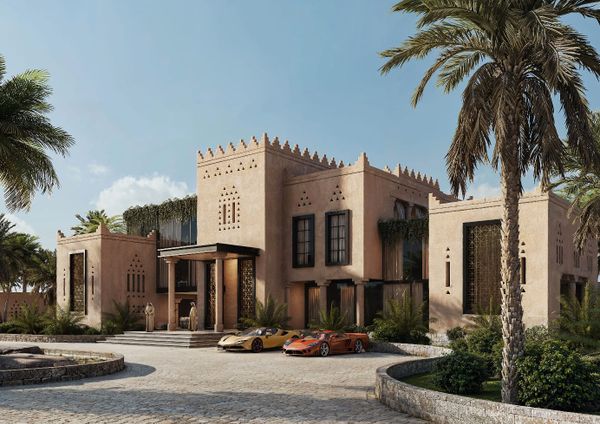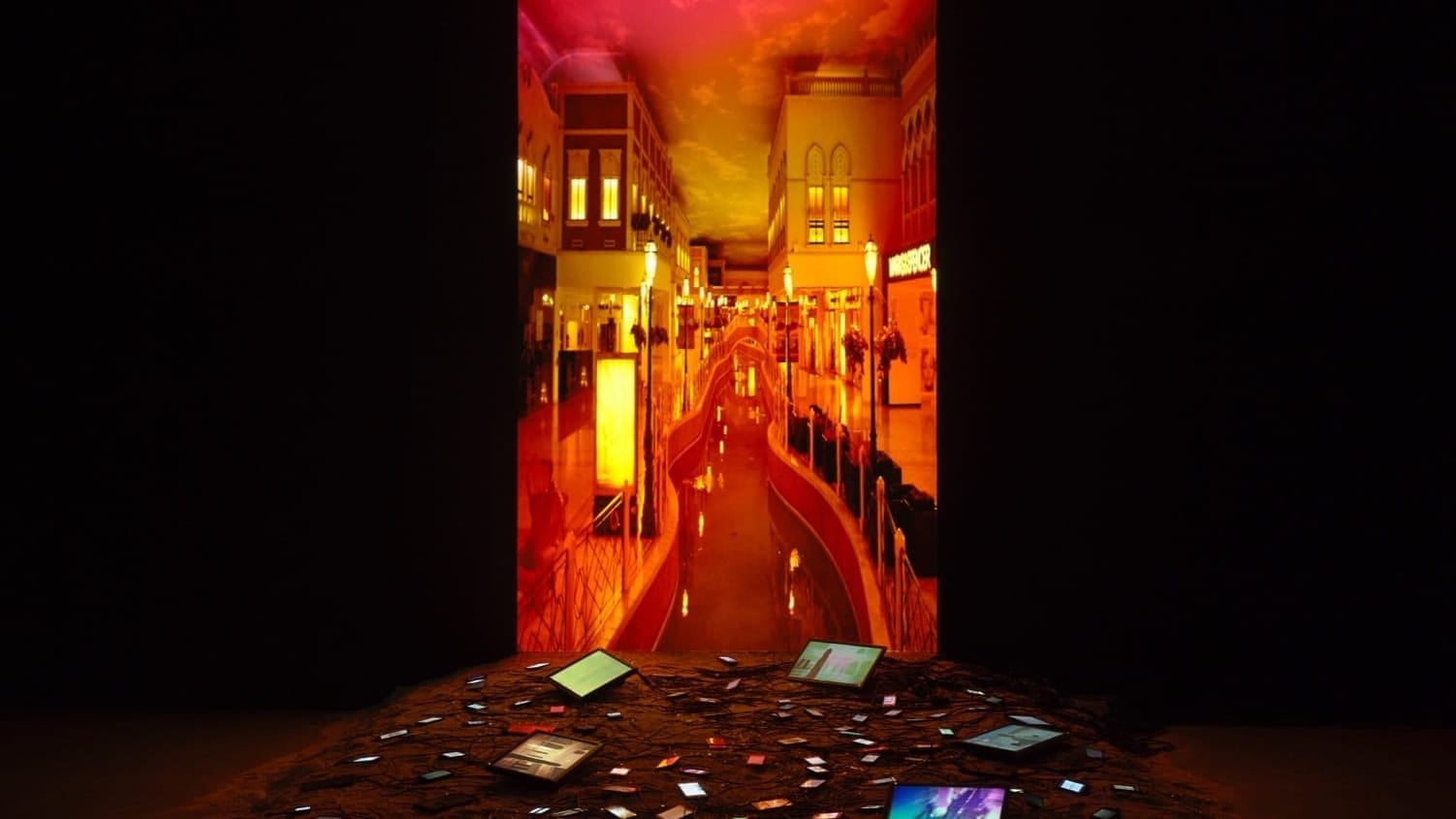
If you ask writer and visual artist Sophia Al Maria, identifying an important cultural trend and becoming its most famous and prolific student, isn’t as easy as it looks. In 2007, she coined the term Gulf Futurism to refer to a phenomenon she observed in the architecture, urban planning, popular culture, and general aesthetics of the Arabian Gulf since the emergence of oil.
Typified by ideas of isolation via technology and extreme wealth, consumerism’s corrosive impact on the Earth as well as on the human spirit, and the replacement of history with glorified heritage fantasy, the concept made a certifiable splash. Al Maria’s work seems to have drawn into focus a previously unidentifiable cultural ennui that, she argues, has now spread beyond the Gulf region.
Since 2007, her writing on the concept has appeared in Harper’s Bazaar magazine and Bidoun, as well as other hip art publications. Her autobiographical novel, The Girl Who Fell To Earth, published by Harper Collins in 2007, examined some of the Gulf Futurist themes that she would later revisit in other artistic formats. Her visual art, mainly comprising of videos (in both gallery-based installations as well as on YouTube), has been exhibited at some of the most important galleries and museums around the world, including most recently, New York’s Whitney Museum and New Museum, and London’s Serpentine Gallery.
But when asked about Gulf Futurism now, on the phone from her base in London, Al Maria becomes (politely) frustrated. After a few sentences describing her uneasiness with where the concept has ended up, nearly ten years after she first identified it, she stops altogether. “I feel really Gulf Futurism-ed out,” she said. “Do you mind if we talk about something else? One starts to feel ridiculous when saying the same thing over and over and over.”
Her swerve away from Gulf Futurism, she says, was tied to her physical move away from the Gulf. Five years ago, a “once in a lifetime opportunity” brought her from Doha to London, where she now works primarily as a screenwriter for film and television.
But it appears you can’t take the Gulf out of the Gulf Futurist, even if she moves to London. Over the course of her subsequent travels for her new line of work, to South Africa, India, and the South Pacific (among many other places near and far), she’s seen evidence that aspects of Gulf Futurism are spreading beyond the sandy shores of the Arabian Peninsula.
On the tiny South Pacific island of Niue, Al Maria was walking on the beach when she found a hat made out of plastic. The island, which has high point of 68 metres, is threatened by rising sea levels; its government is working with its neighbours to organise a plan for population resettlement. The unfairness behind resettling the people of Niue, who have little to do with the melting of the polar ice caps – and the hat – reminded Al Maria of the marginalisation of the Bedouin tribes of the Gulf states (a community her father comes from), and the artefacts that represent them.
“I can’t put these ideas behind me,” she confesses. “The sharp edges between the Bedouins and the oil rich. This thinking about forcible relocation [in the Gulf as well as in Washington state, USA, where her mother hails from] is something that I’m interested in right now.”
The emergence of the ultra-high-net-worth individuals (UHNWI) class, juxtaposed with ever increasing numbers of people that no longer have a home due to environmental degradation, conflict, or political machinations, is no longer a Middle Eastern phenomenon, says Al Maria. “Gulf Futurism no longer applies to just the Gulf. I think that the most dystopian element of Gulf Futurism was wealth being distributed so unevenly between classes in Gulf countries, and the sharpness of race issues and the segregation of genders and classes. This darkness is now something bubbling up all over the world – it’s been happening for years and it’s glaring now.”
How will she express these difficult-to-grasp ideas in a medium that will make sense to viewers? Well, she doesn’t actually want it to make sense as much as she wants it to be experienced, which is why she is drawn so strongly to video. “Some things are a story that need to be told, and some things are feelings that need to be felt,” she says. “Images are much more primal [than the written word] and tap into something that is much more difficult to reach.”
“There was an art exhibition called ‘Virgin with a Memory’ in Manchester,” she says, about the feeling of dread and aggression a woman can get when walking in Cairo. “I know for a fact it made people sick… it was effective.”