Gazing out of my window on the eighteenth floor of Alexandria’s brand new Four Seasons hotel late one afternoon, I watch the waves vigorously attempt to reclaim the city’s new seafront. A howling wind has churned the normally placid Mediterranean into a cauldron of foam and fury and country-sized cumulonimbus skate across the horizon, trailing dark curtains of rain. As the storm blows in, I think how lucky I am to be safe indoors.
I grab my book and settle into an armchair by the window. I am due for a session in an hour’s time at the lovely new spa down on the pool level. After a hard day’s sightseeing, the thought that soon, my aches will be massaged away is almost unbearable.
I crack open EM Forster’s 1922 A History and A Guide and suddenly think how nice it would be to have a steaming cup of cocoa with a splash of Courvoisier. A quick call to room service and voila, five minutes later my mildly alcoholic hot drink arrives. With a marshmallow on the side. Service at the Four Seasons, as I am just finding out, is both swift and comprehensive. I’ve barely finished my cocoa when it is time to get ready for my treatment. A delirious hour-and-a-half later, pummelled beyond all recognition and finally relieved of my aching feet, I float in the Jacuzzi, thinking about my long and very interesting day.
Alexandria is a special place. It is the kind of city where, out of the corner of your eye, you can still sometimes glimpse ghosts of the past. Walking the Corniche that morning I suddenly began to imagine that each passer-by was Archimedes or St. Catherine, Anthony or perhaps King Farouk taking one last look before slipping away into exile. A sudden flash of light became the golden glow of the Lighthouse and the prows of bobbing in the harbour were Caesar’s ships moored by Cleopatra’s palace at Antirodos. Stopping for coffee and cake at the magnificently Art Nouveau Trianon and for a moment, I was suddenly back in the glittering, literary city of the interwar years and was quite sure that Lawrence Durrell’s Leila Hosnani was sitting in a darkened corner studiously avoiding my gaze.
It’s true, I am overly imaginative but Alexandria encourages fantasy. Adrift in time, it is more a state of mind than a geographical entity and until its recent upturn in fortunes – sparked first by the building of its new UNESCO-sponsored Library and subsequently its first five star hotel in decades – its appeal lay chiefly in imagining it the way it was. This is because after Alexandria was abandoned by its Abdel Halims and Leila Mourads and waved goodbye to its crisply clad society ladies and their cotton baron husbands, its fez-wearing bellboys at Belle Époque cafes and its melancholic Russian émigré restauranteurs, it fell on hard times.
As I slipped past the sullen police cordon – complete with armoured car and sandbagged position – at 69, Nabi Daniel Street that morning, I was rudely reminded of just how hard those times were. Beyond the wrought iron gates, stood the white neoclassical bulk of Eliyahu Hanavi, the last functioning synagogue in a city that, 60 years ago, was home to the region’s oldest and largest Jewish community. Today, it stands mostly empty and alone. What struck me was less the fact that Alexandria’s Jews (and for that matter, its Greeks, Germans, Italians, French, Russians, English, Lebanese, Syrians and Palestinians) have emigrated but rather that the few elderly members remaining may now only attend religious services safely because of those guardians.
This is no lament for the Middle East’s fast disappearing religious and ethnic minorities, nor a panegyric for cosmopolitanism bred of colonialism. Rather, it is a simple observation. If in ‘cosmopolitan’ Alexandria, city of philosophers, poets and writers, of openness, tolerance and the love of ideas over ideology, the city where Naguib Mahfouz imagined the new republic’s optimistic future through the guests at the Miramar Hotel, Youssef Chahine learned to see the world through a viewfinder and Egypt’s silver screen lovers came to make (bridled) love by the sea, if in that city, the presence of armoured guards is the only way a small group of elderly Egyptian Jews can attend temple, then Alexandria, Lighthouse of the Mediterranean, has fallen hard indeed.
Feeling nostalgic for a city I never knew, I turned and made my way back to the reassuring confines of the Four Seasons. My walk takes me past St. Mark’s, seat of the Coptic Pope and the largest church in Alexandria, down Rue Fouad/Gamal Abdel Nasser Street/Al Horreya (depending on when your map was printed) where the latest designs from Europe have been replaced by distressed jeans and polyester pants in endless shades of greige and then across the newly rehabilitated Sa’ad Zaghloul Square, past the old Cecile Hotel (now, regrettably, a Sofitel) and onto to the crescent of Art Deco, Art Nouveau and Moresque marvels that line the Eastern Harbour. This was the heart of old Cosmopolitan Alexandria, but the blistered grandes dames I pass along the seafront are dowdy, in need of a good scrub and in some cases, a vigorous architectural nip and tuck.
Walking faster, I lament the passing of the jasmine-scented gardens of Ramleh, where elegant villas wrapped in luxuriant foliage survived well into the 1960s and the silencing of the cosmopolitan babble of languages that once filled these streets. I’m mentally on the verge of hammering the final nail into cosmopolis’ coffin when I reach the Biblioteca.
My melancholy vanishes. Here before me is the largest library in the Middle East and at 212 million USD, one of the most expensive in the world. It’s true, a lot of children could be sent to school with that kind of money but as soon as you see this glass, steel and granite cylinder rise above the 1950s apartment blocks on Shatby promontory, you know it was money well spent.
A slew of articles have been written about how the massive stone walls are covered in inscriptions from all parts and periods of the world, about how the main building, a disk 160 metres in diameter set in a giant reflecting pool is meant to evoke the rising sun, even about the crystalline beauty of the light that filters into the massive reading room where silent ranks of students diligently labour to make sense of their selected texts, but nothing really prepares you for your first sight.
It is an architectural marvel, the contemporary equivalent of the Lighthouse, a building so uncompromisingly modern that the existing urban fabric recoils slightly. Breaking every cardinal rule of the urban planning cannon, the Biblioteca stands magnificently at odds with its surroundings. Perhaps more importantly, it is a very visible sign that someone somewhere believes in Alexandria’s future.
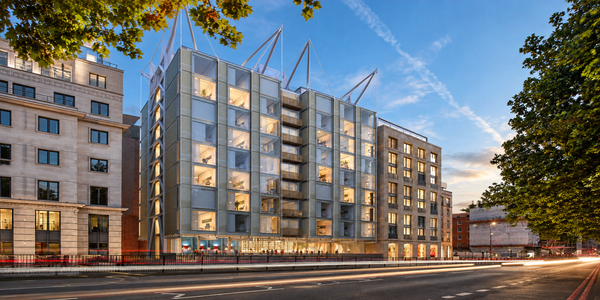
Revitalised, though sodden after a wave of spray catches me by surprise, I have become oblivious to the peeling facades of the wall of apartment blocks that runs from to Montazha. I pass Stanley, with its little beach and triple tier of chalets and see the Four Seasons, a Palm Beach pink Leviathan that towers over the San Stefano sea front.
The hotel itself is a single bijou tower of 118 rooms but it is surrounded by the massive 30-storey condominium complex and shopping centre that together with the hotel make up the San Stefano Plaza. Similarly pink, it is one of the largest structures in the city and like the Biblioteca, another sign of resurgent interest in Alexandria.
Turning that interest into a broader renaissance is exactly what Four Seasons staff have in mind. The hotel’s restaurants, in particular Byblos, Alexandria’s first experience of haute Lebanese cuisine, have revolutionised the local dining scene. The new marina being built across the Corniche has been copied by nearby hotels, bringing beach culture back into the heart of the city and finally, the arrival of a world-class hotel marks a welcome return to the days when Alexandria was the destination of choice for affluent travellers from all over the world.
A new library, a new hotel, a new lease on life. Alexandria seems poised to enter its third Golden Age. The first lasted seven hundred years and ended with Cleopatra and her asp. The second lasted barely a hundred and ended with the departure of Alexandria’s internationals. In between, there were fifteen hundred pretty empty years.
More confident that it has been for decades, Alexandria is betting its next moment of glory is dawning and like the investors behind its big new hotel, Alexandrians must surely hoping that when they do return, this time, the good times will roll for much more than a century.
Contact
Four Seasons Hotel
Alexandria, Egypt
Tel
www