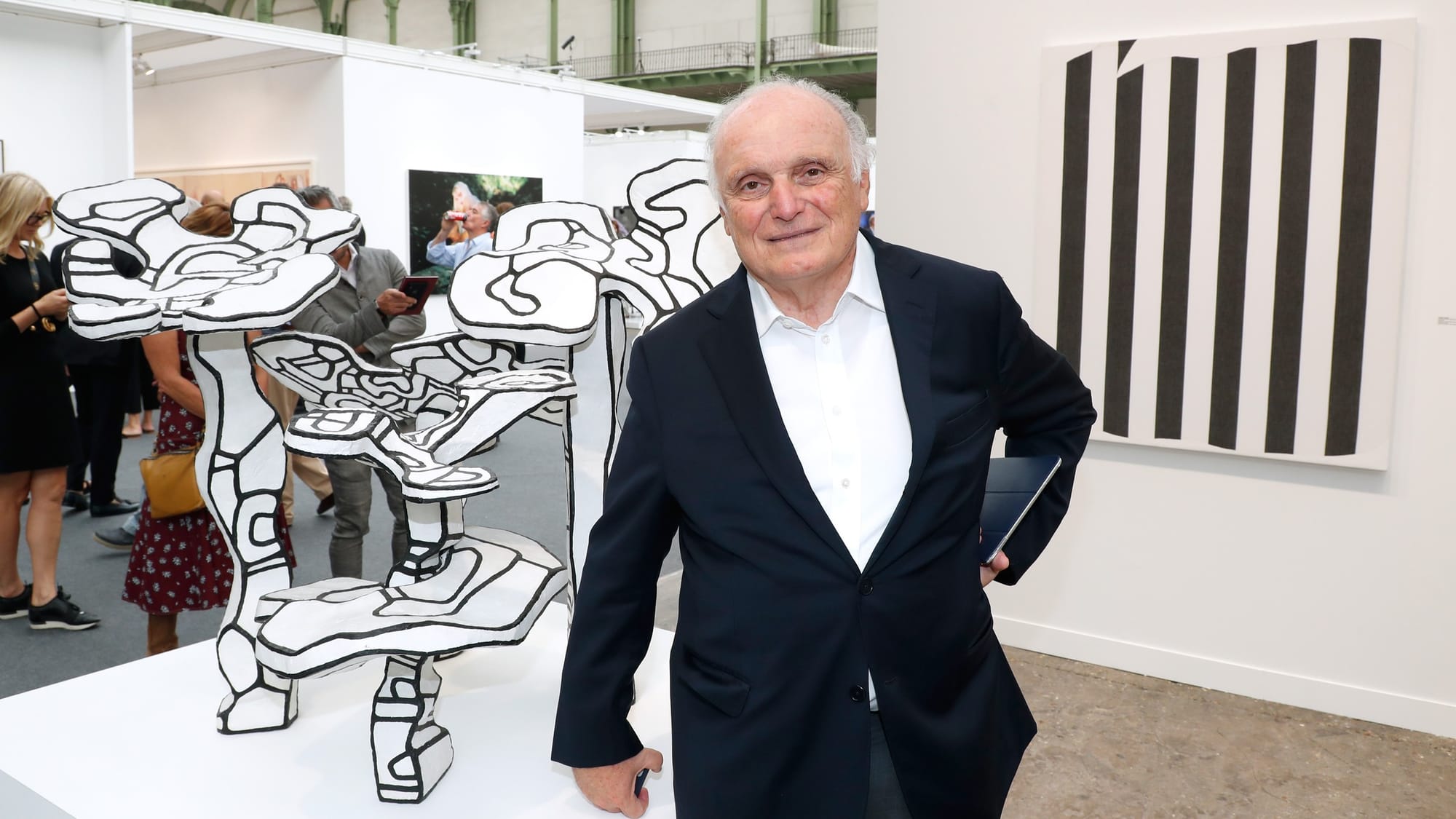
David Nahmad was born in 1947 in Lebanon to a Jewish family from Aleppo and grew up in Italy. Sometimes referred to as “the man with a thousand paintings”, he is one of the world’s leading art […]
David Nahmad, does your passion for art originate from your elder brother Giuseppe?
Yes, he was a visionary collector with a feel for things. He bought Magritte before anyone else. He bought Giacometti before anybody else. He bought Juan Gris before anybody else. He bought Francis Bacon before anyone else. He was surrounded by architects, by great art critics, by the artists themselves. in the years ‘63-64, artists such as de Chirico, Fontana and Giacometti often came to our house, as did the two Pomodoro brothers – Italian sculptors who my brother paid a salary of about 500,000 lire a month – and Fontana did some work in the house.
When did you and your brother Ezra start dealing in art?
In ’67-’68 we started selling some of my brother Joseph’s works. He had other activities and he wasn’t a dealer, he was just a collector, but when we started selling paintings for twenty times what he had paid for them my brother told us that we had to learn more about the art world, because the art market behaves very differently from the property market and the stock market. In Italy in the ‘60s we had some very difficult times. The only market that was going the other way was the art market.
David Nahmad, did you buy important works In Rome in the ‘60s with your younger brother Ezra?
At that time we bought Italian painters: Campigli, Morandi, Sironi, Marino Marini, Severini, and we even bought a very beautiful Modigliani, but it was all very tentative. There wasn’t a fil rouge. In the morning we’d buy a Bacon and in the afternoon we’d buy Campigli. Then we’d buy an Utrillo or a Schwitters or a Max Ernst. The first Max Ernst we bought was in ’65 and we paid £5,000 for it. We bought a Kandinsky for £6,000, a Paul Klee for $10,000, some Miros for $15,000 – even some Picassos for $5,000.
Is it true that your motto is ‘buy and hold’?
Yes, if we can. Unfortunately, sometimes we have to sell because we have to pay for new purchases. You can’t keep everything in life. Sometimes we have big payments to make, so we sell two or three things to ease the burden of the purchase.
Do you mainly buy at auctions?
Yes, because if someone says to me, “So-and-so needs money, you can buy his collection,” I don’t feel comfortable with that. It bothers me. I don’t want to take advantage of someone’s misfortune to make money. At public auctions my conscience is clear.
They say you have collected 4500 paintings.
4500 paintings doesn’t mean anything. In 1975 we bought 200 Vasarelys and some Rotellas. They’re not very important artists, but 200 paintings here and 300 paintings there adds up. But you can’t count them as serious works. In our collection we have approximately 600 or 700 serious paintings.
What will you show from the 28th March to 29th June at the Museum of Impressionism opposite Monet’s house in Giverny in the exhibition ‘From Monet to Picasso’?
There will be 57 works in Giverny, some very nice Monets, some beautiful Renoirs, some beautiful Degas, some lovely Toulouse-Lautrecs. There are Italian painters: Boldini, Fattori, Zandomeneghi, Spadini. We also have Odilon Redon, Gustave Moreau. Delacroix’s ‘A Jewish Bride in Tangier’ is a masterpiece.
Are you also showing elsewhere?
At the moment we have works on loan to the Tokyo Museum and we lent 15 Miros to the Metropolitan. Then we will lend some works to the Matisse Museum in Nice, and some works to the Fabre Museum in Montpellier, and we will have three masterpieces by Kandinsky in the Barberini Museum in Potsdam.
Did you buy a lot of Kandinskys?
Yes, in ’71 we bought almost 75 per cent of the sale. Even the auctioneer doubted that we would pay because I was only 23 years old, but I paid for everything, with the help of my brother Giuseppe.
Are you the biggest collectors of Picasso paintings outside the Picasso family?
Maybe we have 150 or 200. But the number of paintings means absolutely nothing. It’s the quality that matters. We have maybe 50 very important paintings by Picasso. The others are beautiful paintings but not as valuable as ‘The Flower Girl’ sold by the Rockefeller estate, or ‘Paulo Dressed as a Harlequin’, or ‘The Women of Algiers’, or ‘Luncheon on the Grass’, which are very famous paintings. ‘The Women of Algiers’ is on loan to the Louvre.
Where did you buy your three different versions of ‘The Women of Algiers’?
We bought one of the versions at the Sotheby’s sale after the death of Victor Ganz. We bought the second one at Christie’s after his wife Sally died, and we bought the third one at Sotheby’s on the open market. They are the H, J and C versions. The funny thing is that H and J happen by chance to be the initials of my two boys, Helly and Joe.
David Nahmad, are your family really dealers or collectors?
My family bought paintings when nobody wanted to buy – and not for speculation, but out of passion. We loved art. We thought it was great. We’d see a beautiful painting and say, “We can’t miss it, we have to buy it even if we don’t have much money.” Then we managed to find the money.
Your father was a banker in Aleppo and a stockbroker in Beirut before moving to Italy?
My mother’s name is Safra and my grandfather Joseph Safra founded Banco Safra in Brazil. We won and also lost money on the stock market, especially on the Milan Stock Exchange in 1963 when nothing was selling. The only thing we could sell to make a living were paintings by people like Spadini, Boldini, Morandi, and de Chirico. Art was liquid, and because it was liquid there was a certain demand. That’s when my brother told me that art is where you have to be.
Where were you based?
In Milan. Then the wife of the director of my father’s bank asked me if I could help her open a gallery in New York. It was very convenient because it was at the beginning of the Red Brigades in Italy, the years ‘74-75. I had just got married and was afraid of kidnappings. Unfortunately, when I arrived in New York, there was the oil crisis disaster and the American stock exchange collapsed. An apartment in New York was worth a dollar because people couldn’t afford to pay the taxes and upkeep on property. On the other hand, a Gauguin would sell for a million dollars.
Who have you met who really understood art?
Ernst Beyeler, Heinz Berggruen, Aimé Maeght, and people who had extraordinary collections like Thyssen and Agnelli. I was lucky enough to become friends with Mr Kahnweiler, Mr Maeght, Mr Beyeler, Mr Berggruen, and to have worked with them, not superficially but in depth. They trusted me, and the best part of my life was working with people on trust. Even Christie’s and Sotheby’s worked with me on a basis of trust.
What did people like the collector and dealer Daniel-Henry Kahnweiler and Heinz Berggruen teach you?
A lot of things, but it was the great Italian art critics who really taught me. The first buyers of American Pop Art were the Italians. The Rothkos, the Twomblys…. The first Basquiat exhibition was in Modena. It wasn’t in Philadelphia, because the Americans didn’t get it. The Italians understood before anyone else and bought Miro, Picasso, Kandinsky and Léger when the French were mainly interested in the Paris School, the Impressionists and furniture.
Do many great paintings hang in your home in Monaco?
I only have a few paintings on the walls because I don’t want to be pretentious. There are people who like to accumulate paintings a few centimetres apart and put up painting after painting. That’s like putting your bank account on the walls.
Did you and your brother buy many artists when they were inexpensive?
We paid 500,000 lire for Fontana and $500 for the first Magritte. It was ’The Legend of the Centuries’ and we sold it to Sophia Loren in ’68 for $10,000. Today that painting is worth $25 million. This is how it is for certain artists, such as Magritte, Miro, Picasso, Matisse, Modigliani, Kandinsky, Mondrian and Dali.
You also have sublime Monets and Impressionists…
A beautiful Monet is very expensive today and impossible to find, as is an extraordinary van Gogh, a Tahitian Gauguin, Cézanne’s Montagne Sainte-Victoire, or a Picasso from the Blue Period like ‘The Harlequin’. Matisses are impossible to find. Even the Magrittes that have come up for sale recently have fetched huge prices, because the number of collectors in the world and people’s wealth has increased enormously. When I was 18, the richest men in the United States like David or Nelson Rockefeller were estimated at $500 or $700 million. Today we’re talking about $50 billion or $100 billion.
Do the wealthy Silicon Valley people buy art?
Some do, like Paul Allen, Jeff Bezos, Bill Gates. But I remember when I went to Christie’s auction rooms in London and there were 30 people in the room, no telephones, no internet, no journalists, no private collectors. The Mellons, the Chryslers or the Fords didn’t come to the sales themselves. They sent delegations from Wildenstein, Knoedler, Marlborough. These big galleries, especially Knoedler, were very important when I was young. I’m talking about 1966, when we bought Bacon for £800!
David Nahmad, what do young collectors want today?
Young people with lots of money have advisers who, unfortunately, don’t understand anything. Advisers are like bankers. The banker comes to you and says: “Today, David, you have to buy such and such a share.” It doesn’t go up, it goes down. He says, “I’ve changed my mind. You have to sell it,” and you take a loss. The bankers change their mind almost every day, whereas if I tell you that you have to buy Picasso, I said it twenty years ago, I’m saying it now, and I’ll be saying it in twenty years’ time if I’m still alive.
What would your advice to them be?
To only buy if they understand. They have to buy art books, go to museums, go to fairs and auctions. They have to educate themselves. A collector must not listen to what others say or act like buying Apple because a banker says to buy Apple. Apple is very good, but it can go down 20% or 30%.
Born in Lebanon, do you speak Arabic and have Arab clients?
Yes, Arabic is a very important language and I speak Arabic very well to those clients. Jews and Arabs are cousins. When the Gestapo came to Syria to deport the Syrian Jews, the Arab Muslims protected the Jews. This shows how much the Arabs and the Jews love each other. It’s a great shame that we have this stupid war, because they can live together very well. My Jewish banker father’s two biggest customers were Muslims. They trusted him. My cousin Edmond Safra made his fortune with the Arabs, not with the Jews.
You were the World Backgammon Champion in 1996. Do you like to play?
I don’t think Backgammon is really a game, there’s calculation involved – like chess and bridge – and you need a bit of luck. I used to play 4 or 5 hours a day, every day, in tournaments all over the world. I don’t play every day anymore, but Backgammon is a beautiful game, because you often get into trouble and have to use your imagination to get out. That’s why it’s called ‘back’-‘gammon’ – when you can no longer attack, you have to defend.
Did you play professionally?
No, I was a passionate enthusiast. I only ever played for a little money, because I’m not interested in winning from other people. It bothers me. A small amount is fine, because it doesn’t hurt anyone. Just as I can’t sell a painting to someone who doesn’t understand art.
Do you still buy a lot of paintings?
Yes, recently we have bought two spectacular Dubuffets, three magnificent Picassos, some Calders. We have had a very nice exhibition in Gstaad called ‘Calder in Flight’ at Saanen Airport, where every year we rent space for a month.
Are you going to create a Nahmad Museum or Foundation?
We lend to museums all over the world. We have participated in many exhibitions and see no point in a foundation that people have to come and visit. It’s better if the works can travel. That way everyone can see them.
If you could only keep one painting what would it be?
I love ‘The Women of Algiers’, especially the H version. I’ve lent it to the Louvre, and to the Invalides, and to the Reina Sofia.
Are there some paintings that you regret not having bought?
Lots. I was the underbidder on van Goghs that are now worth 200 million euros. But it’s good to have regrets, because you have to have defeats. Sometimes I bought paintings that were too expensive.
Have you ever bought forged paintings?
Yes, and my brother Joe bought a few, including a small Miro at an auction in Italy without seeing it. When he saw it he felt a bit ill. He realised it was a fake. What’s dangerous today is not forgery, but the provenance. If you buy a fake you lose money. If you buy a stolen painting, you go to jail.
Do you have to like a work to buy it?
No, you have to understand it. Marcel Duchamp’s ‘Fountain’ urinal is ugly, but if tomorrow someone offers it to me I will buy it because it is important in the history of the development of the world. There is also a phrase by Fernand Léger that says: “The pretty is the enemy of the beautiful”.
Are you still passionate about art?
Yes, definitely. For me, to sell a work of art to someone is first and foremost to protect it. If I were in property, I would want to sell the best building. If I had a friend, I’d tell him what I would have bought. I wouldn’t want to sell him something that was worthless. What’s the point? I do not want to take advantage, or to make people lose.
David Nahmad, thank you very much.