“Wow! That’s tough!” This is embarrassing – I appear to have floored the world’s greatest living tenor with my first question: what, in his opinion, has been his most powerful role or performance to date. We’re sitting in the Four Seasons Hotel in Doha. Placido Domingo has been rushed from a delayed flight to a press conference, and now is conducting a series of television and one-on-one interviews. You could easily forgive him for being testy, or even monosyllabic in his answers. However, apart from a polite request to move out of a ferociously air-conditioned room as it is not good for his voice, he is charming, chatty, and probably the most charismatic yet approachable person I have ever met.
On stage and screen, and in the recording studio of course, Spanish-born Domingo is world renowned. Exponent of over 120 operatic roles, winner of nine Grammy and two Latin Grammy awards, and a respected conductor, he is a formidable figure on today’s classical music scene. Even before ‘The Three Tenors’ concert in partnership with Luciano Pavarotti and Jose Carreras in the 1990s and early 2000s catapulted him into the A-list of celebrity, he was revered by musicologists, conductors and fellow performers as a man who could captivate an audience and offer new interpretations of classic roles such as Radames in ‘Aida’, Edgardo in ‘Lucia di Lammermoor’ and Cavaradossi in ‘Tosca’, all tragic operas where an artist’s mettle is tested to its limit.
So does he find that there is more power in tragedy? “I am a masochist when it comes to the stage,” he explains. “The more I suffer, the happier I am. But that is only for the stage. And I am able to transmit it [the power of music] to people.” And it is his first performance of the tragic role of Otello in Verdi’s eponymous opera that he finally selects as his most powerful. “It was the day that I was going to sing my first Otello in Hamburg. I was very young, I was 34 and it was 1975 and of course it was a lot of excitement for me as it is a role that obviously takes part later in a performer’s life. But to be 34 and to do Otello for the first time it was really a power expected and a power delivered.” His interpretation of the role of the tragic General, destroyed by his own jealousy and mistrust, famously led to a record 101 curtain calls at the Vienna Opera House in 1991.
With a career that has taken him to the world’s greatest opera houses in Milan, New York and London, Domingo also tours as extensively as his schedule allows, despite his 67 years. After all, this is the man whose motto is: ‘If I rest, I rust’. Although visiting Doha for the first time as a guest of United Development Company and their project The Pearl-Qatar, he has sung in the Middle East before, most notably at Lebanon’s Baalbek Festival in 2004. As he reminisces, his voice softens, “I have to say that it [Baalbek] is magic. Just the setting it cannot be better, you know? I have never seen in any other place in the world the roof in some parts and other big pieces of the roof fallen down and lying around. Certainly it is a magic, magic, perfect place.”
As a travelling performer who can sometimes be seen performing in three different concerts in the space of a week, how does he maintain his renowned power over an audience? “It is a matter of concentration. It is a matter of thinking that this is it – and you cannot go away. And since you cannot go away, you had better do it as well as you can. And of course the experience you know,” he explains.
As an experienced performer and music administrator, Domingo has also branched out into conducting, working with orchestras in Europe and the US, and is the founder of the ‘Operalia’ competition, acting as mentor to the winners of this operatic contest and providing their early careers with much needed exposure. “I am proud of that achievement; promoting youth, nurturing talent,” he says. He takes his responsibilities as a virtuoso seriously, continually searching for new operas that can be premiered. Following the press conference and a quick conversation with an admirer who also extols the virtues of our music traditions, he asks his aides to find out whether there are any operas written by Arab artists that he could listen to, and whether he could perform them.
Although opera has not had a traditionally large following in our region, Domingo is passionate about its ability to communicate to and move us all. “It is something we all have, all the people in the world, we have a voice. Some of us, perhaps, we have a better one. But the amazing thing is that you can hear a story. The more people that are there, the more enthusiastic they get, so it is a kind of an exchange between the public, the orchestra and the singers,” he says.
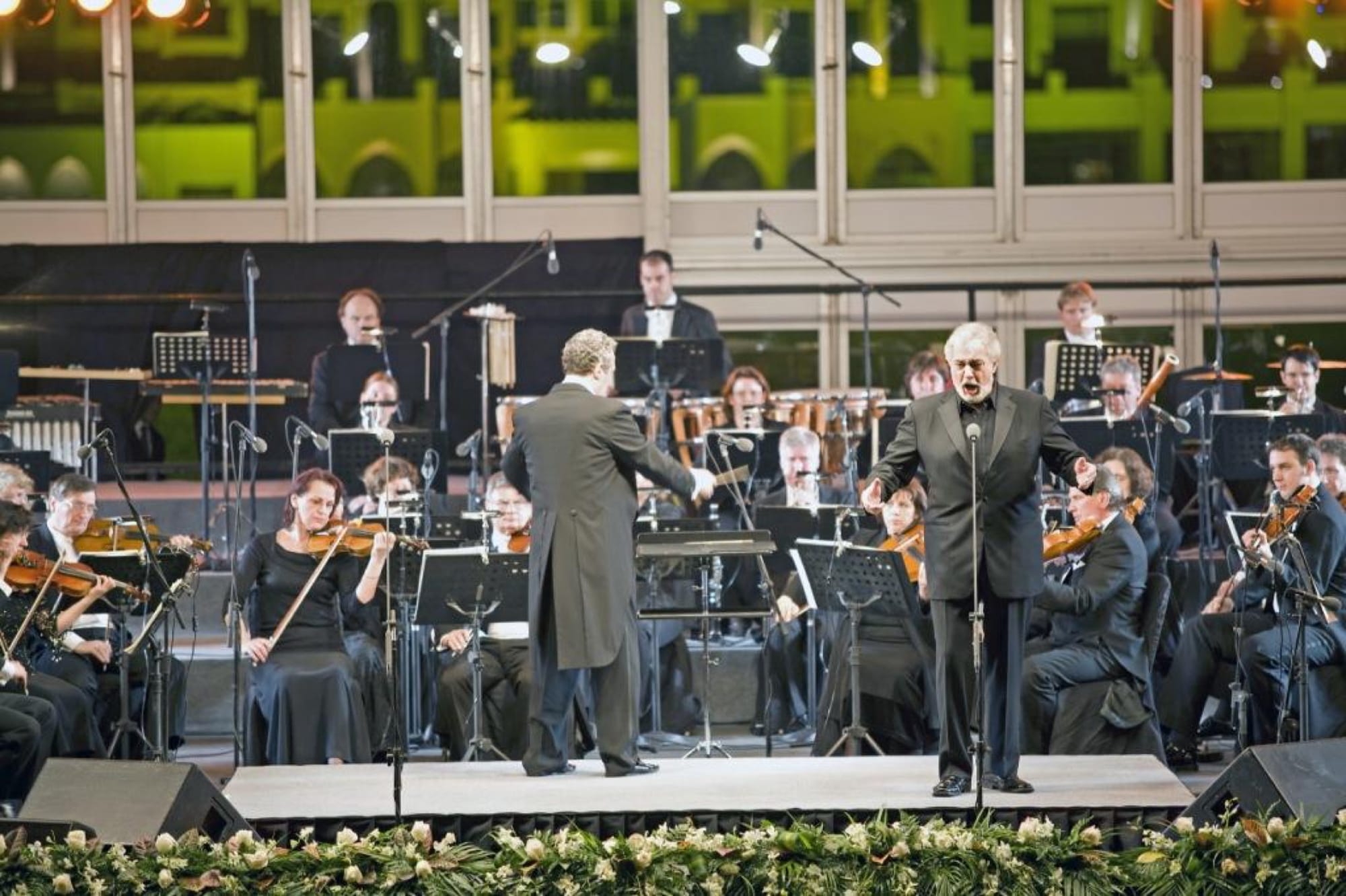
Listening to him two days later, performing a selection of operatic arias, and more modern twentieth century works, I can see how the maestro holds the audience in the palm of his hand. Pacing the stage, using his whole body to express the emotion of the characters he recreates, his voice soars, filling the concert hall with its strength and resonance, giving many people present their first, and likely their best encounter with the power of opera they will ever experience.
Contact
The Pearl-Qatar
Doha, Qatar
Tel + 974 446 3430
www.