Maybe it is because he has accomplished what very few others have, or maybe it is because without him, Apple wouldn’t exist in the form it is today. A college dropout at 21 years old, Steve Jobs co-founded Apple in 1976 in his garage, with long-time friend (and fellow Hewlett-Packard intern in high school) Steve Wozniak. It took the sale of Jobs’ Volkswagen and Wozniak’s scientific calculator to start their company, which in 10 years became a 2 billion USD business with over 4,000 employees. But it wasn’t all that easy; there were quite a few hardships along the way.
Jobs was fired at 30 by the very man he recruited as ceo in 1985, John Sculley. They didn’t see eye to eye. “Getting fired was the best thing that could have happened to me,” Jobs admits. “The heaviness of being successful was replaced with the lightness of being a beginner again, and it freed me to enter one of the most creative periods of my life.” He was ‘returned’ to Apple in 1997 with full force, after having founded another company in the interim, a development organisation for higher education and business markets, NeXT Inc., which had actually failed to make it. In a surprising turn of events, Apple bought NeXT to win him back. Incorporating these lessons of failure, the operating system, which he had attempted to create for NeXT, became MacOSX, the essence of Apple today and which also became the platform for the iPhone.
Jobs found himself embarking on a journey that has changed the face of technology for generations to come. It was the route to the establishment of his 350 billion USD behemoth that became Apple. By adding an aesthetic sensibility that so characterises Apple today, this design genius revolutionised not just the way we perceive personal computing, with the iBook as early as 1999, but also the field of music when the iPod replaced the MP3 player in 2001. And then phones, with the indomitable iPhone in 2007. (He has even greatly impacted animated film and graphics with his company Pixar in 1986). It was not just technology for technology’s sake; with each new product Jobs personally introduced to the public, he had also created something beautiful to own and use. As early as 1984, Steve Jobs had the view of Apple as appealing to “a different type of person—a person who doesn’t want to wait five or ten years to have someone take a giant risk on him or her. Someone who really wants to get in a little over his head and make a little dent in the universe.” And that, he did.
And so how exactly did he get there in the first place? According to Jobs himself, it all started before he was born. At one of his most recognised speeches at Stanford’s commencement in 2005, Jobs reveals the story of his life. “They are only three,” he says wryly. But it is these three who may explain the man he is today. The fact is, Steve Jobs is the adopted son of Paul and Clara Jobs. As a boy, he would work with his father (who was a machinist) on electronics in his garage. His actual parents were unmarried and still graduate students at the time of his birth, so they decided to give him up for adoption. His biological father, Abdulfattah John Jandali was Syrian, from Homs, who emigrated to the U.S. in the 1950s and soon became a political science professor, and his mother, American Joane Simpson later raised his sister Mona Simpson after his father had left. The only condition for adoption was: Jobs must go to university and his adoptive parents had to be university graduates. Although his adoptive parents did not actually graduate from university they did vow to put Steve through college. “This is the closest I’ve ever gotten to a college graduation,” Jobs admitted at that same commencement speech that has won people the world over. He explained how he did not see the use of spending his working-class parents’ lifetime savings and dropped out after the first 6 months, only to attend classes for the next 18. He was at Reed College in Oregon, which was just about as expensive as Stanford.
“I had no idea what I wanted to do with my life. And it wasn’t all that romantic… I slept on the floor in friends’ rooms, returned coke bottles for the 5 cent deposits to buy food with, and walked 7 miles across town once a week to get one good meal at the Hari Krishna temple.” But he did take a class in calligraphy - Reed at that time offered the best calligraphic instruction in the country - which absolutely fascinated him, especially the different typefaces he learned. “It was beautiful, historical, artistically subtle in a way that science can’t capture,” Jobs recalls. But little did he know that this would change everything for him. “None of this had a hope of any practical application in my life. But 10 years later, when we were designing our first Macintosh computer, it all came back to me. And we designed it all, into the Mac. It is the first computer with beautiful typography. And since Windows just copied the Mac, it is likely no personal computer would have the multiple typefaces or proportionally spaced fonts if I hadn’t taken that course. Of course, it was impossible to connect the dots looking forward when I was in college, but it was very clear, looking backwards, after those 10 years. You have to trust in something: your gut, destiny, life, karma, whatever. Because believing that the dots will connect down the road will give you the confidence to follow your heart, even when it leads you off the well-worn path.”
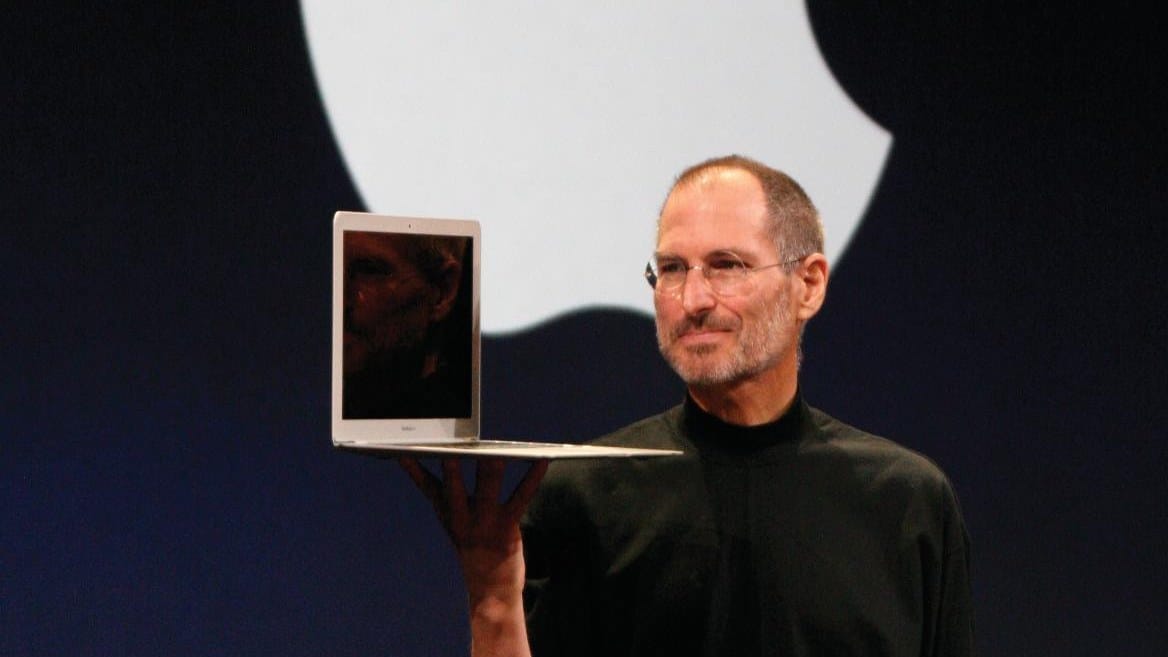
Even if institutionalised, Jobs is still that maverick who has strayed from the beaten track, and everyone knows it. Upon each product launch, Steve Jobs would appear in his trademark attire: signature black turtleneck and jeans. It has been said that his closet contained over a hundred replicas of this basic outfit, as if to designate an unchanging Jobs amid all the innovations. In giving himself almost no choice, he provided Apple users with plenty. Steve Jobs is an idea as much as he is the man. And now, even if the idea is steadfast and enduring, Steve Jobs the man is virtually impossible to reach. Steve Jobs, the man, is dying.
After being on medical leave in 2009 for 6 months due to the onset of pancreatic cancer, he has now announced his resignation as ceo due to the deteriorating state of his health. He will remain the chairman, albeit behind the scenes. But many believe he will never return. He is now 56 years old and people have been following his health almost as avidly as the next iconic product Apple dishes out. A week after his reported medical leave, Apple’s stock prices lost 15 billion USD. But the company’s share price has since doubled, making it the second most valuable stock after the oil giant, Exxon Mobil.
At an iPod launch in 2009, the giant screen behind a visibly gaunter Jobs displayed the following Mark Twain quotation: “The reports of my death are greatly exaggerated.” But the fact is, Steve Jobs has been battling his mortality in the same way he has battled the death of each new Apple product. The truth remains: technology is vulnerable to its own deaths, to crashes, bugs that need to be fixed and improvements and add-ons becoming necessary once tested in the market, without which technology would not survive. Steve Jobs in over 3 decades, has created and reinvented the idea of Apple, which many argue is in his own image. But sadly, and for the first time, the realisation has set in that Apple is going to outlast him. What comes after the machine? As early as 1985, Steve Jobs said, “I’ll always stay connected with Apple. I hope that throughout my life I’ll sort of have the thread of my life and the thread of Apple weave in and out of each other, like a tapestry. There may be a few years when I’m not there, but I’ll always come back.” But his own extraordinary creation will have to overshadow even the image of Steve Jobs this time. It is difficult to say what Apple will be or become without Jobs. And only time will tell just how synonymous Jobs is with Apple.
For now, his successor, Tim Cook, will lead the company’s 50,000 strong staff. He had run the company in the past, in 2004, when Steve Jobs first had surgery for his tumour and then in 2009 during his liver transplant. It is true that Apple has always been farsighted and Steve Jobs explained in the 2010 All Things Digital conference that it was the first to do away with the floppy disk and adopt the USB. “Sometimes you have to pick the things that are going to be the right technological horse to ride forward, to look at technologies that have a future. We try to pick things that are in their springs. And if you choose wisely, you can be quite successful… we’re going to focus on technologies that are in ascendancy. If we succeed, people will buy them. And so far, I have to say, people seem to be liking the iPad. We are selling an iPad every 3 seconds.” The iPad was launched in 2010 and just this June, Jobs introduced the iCloud, a music and date streaming device. He may be getting exceedingly frail, but he is still unstoppable. At the same conference, he admitted, “I have one of the best jobs in the world. I get to hang out with some of the most talented, committed people around and together we get to play in this sandbox and build these cool products… Apple is an incredibly collaborative company. You know how many committees we have at Apple? Zero. We’re structured like a start-up. We’re the biggest start-up on the planet.”
And now as one of the stars behind this ‘start-up’ grapples with his own life and death, his words at the 2005 commencement speech, after which he thought he had one of those rare, curable forms of pancreatic cancers and was fine now, have never rung more true: “Remembering that I’ll be dead soon is the most important tool I’ve ever encountered to help me make the big choices in life. Because almost everything — all external expectations, all pride, all fear of embarrassment or failure — these things just fall away in the face of death, leaving only what is truly important. Remembering that you are going to die is the best way I know to avoid the trap of thinking you have something to lose. You are already naked.” After his surgery, he thought he was the closest he has ever been to facing death, and since then it could only exist as a purely intellectual concept. “No one wants to die. Even people who want to go to heaven don’t want to die to get there. And yet death is the destination we all share. No one has ever escaped it. And that is as it should be, because death is very likely the single best invention of life. It is life’s change agent. It clears out the old to make way for the new. Right now the new is you, but someday not too long from now, you will gradually become the old and be cleared away… Being the richest man in the cemetery doesn’t matter to me… Going to bed at night saying we’ve done something wonderful… that’s what matters to me.” Amen.