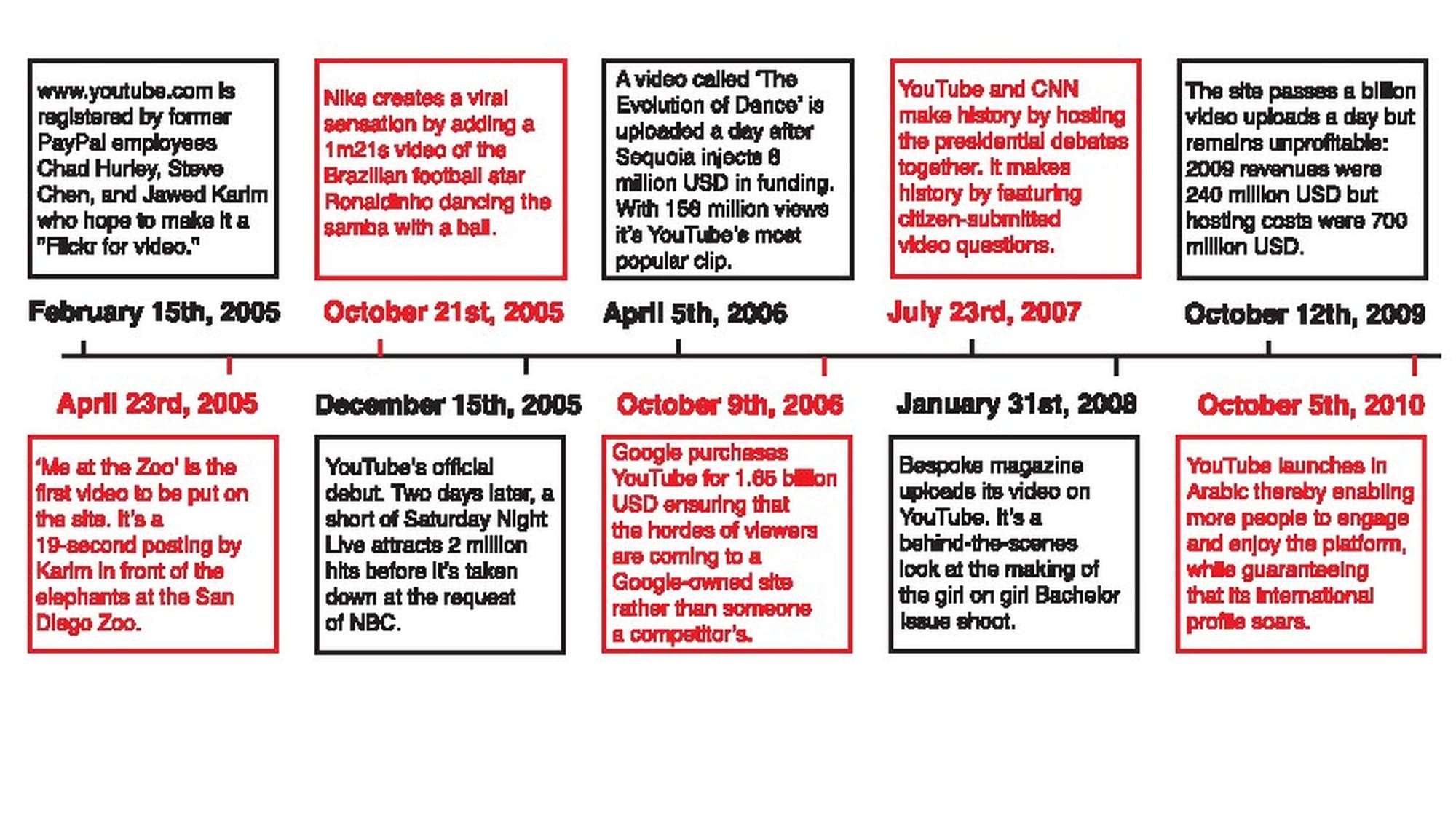
February 15th, 2005
www.youtube.com is registered by former PayPal employees Chad Hurley, Steve Chen, and Jawed Karim who hope to make it a "Flickr for video."
April 23rd, 2005
‘Me at the Zoo’ is the first video to be put on the site. It’s a 19-second posting by Karim in front of the elephants at the San Diego Zoo.
October 21st, 2005
Nike creates a viral sensation by adding a 1m21s video of the Brazilian football star Ronaldinho dancing the samba with a ball.
December 15th, 2005
YouTube’s official debut. Two days later, a short of Saturday Night Live attracts 2 million hits before it’s taken down at the request of NBC.
April 5th, 2006
A video called ‘The Evolution of Dance’ is uploaded a day after Sequoia injects 8 million USD in funding. With 158 million views it’s YouTube’s most popular clip.
October 9th, 2006
Google buys YouTube for 1.65 billion USD ensuring that the hordes of viewers are coming to a Google-owned site rather than someone else’s.
July 23rd, 2007
YouTube and CNN make history by hosting the presidential debates together. It makes history by featuring citizen-submitted video questions.
January 31st, 2008
Bespoke magazine uploads its video on YouTube. It’s a behind-the-scenes look at the making of the girl on girl Bachelor Issue shoot.
October 12th, 2009
The site passes a billion video uploads a day but remains unprofitable: 2009 revenues were 240 million USD but hosting costs were 700 million USD.
October 5th, 2010
YouTube launches in Arabic thereby enabling more people to engage and enjoy the platform, while guaranteeing that its international profile soars.
Section: vision / notable
Writer: Louis Parks
Native expression
Google’s subsidiary site, YouTube is something of an Internet behemoth. According to alexa.com, the influential Internet ranking service, the site is the third most popular in the world, behind google.com and Facebook. Yet even though its popularity is global, its language functionality is not: Arabic speakers were relegated to simply posting comments.
That all changed last October when YouTube launched its Arabic interface: Now users can simply choose the location from where they’re viewing the site and the new Arabic services automatically kick in. There are contextual menus, dedicated channels and even a virtual Arabic keyboard that helps avoid the input issues common to other websites while it’ll also save you from dealing with the foibles of English-Arabic translation.
Is it worth it? While Internet access is by no means universal in the region - which might have something to do with the fact that Arabic was only the 36th language to be made available on the site – according to leading telecom research figures, a full 40 per cent of all online traffic in the Arab world goes to YouTube. Given the global context, the site’s regional fanbase can only increase now that hundreds of millions of native Arabic speakers have the ability to adjust the content they wish to watch to their native language.
Of course, Arabic speakers have long used the English-language version of the site, but the implications of YouTube opening up to people for whom Arabic is their only language are of great interest. No longer are we dealing with a site that requires a basic grasp of English, it’s now out there for those that have little global exposure. Naturally there’ll be much more Arabic content as a result, which should increase the size of YouTube’s Arab community but it should also revitalise the potential for cultural exchanges between users – as long as they don’t waste their time on ‘Charlie Hit Me’ videos.
Finally, and perhaps most importantly, YouTube operates free of the local political restrictions that govern the content of Middle Eastern-based video sharing sites, such as iKbis or D1G. Therefore, by creating a truly accessible platform for the spread of ideas and cultural exchange, YouTube rightly deserves a nomination in this year’s Visionary Award.
WHAT YouTube Arabic
FOR Arabic speakers to upload, share, and view videos and converse with their peers
HEADQUARTERS San Bruno, California, U.S.A
WHY One of the most popular sites in the world has just been opened up to a Middle Eastern audience, allowing the sharing of ideas, creative expression and a sense of community.
www.youtube.com