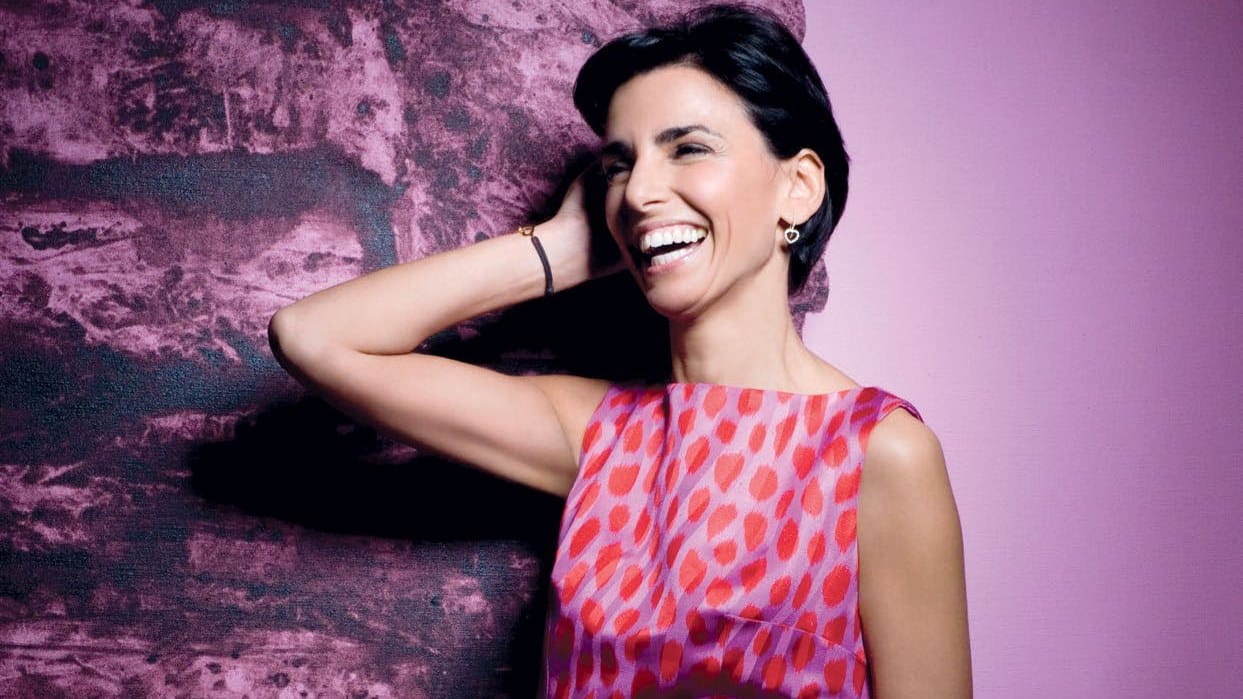
Rachida Dati is immediately imposing. First, there’s the evident self-confidence that comes from her rise from Arab workman’s daughter to one of the most senior politicians in the French Government. Then there are the striking good looks that have marked out the former Minister of Justice ever since she became a public figure in France. Today, sitting in her office in the 7th arrondissement on the Left Bank, Dati is as stylish as always: jeans, black jacket, towering high heels.
She vividly describes the prejudice she’s faced as a high-profile figure whose childhood was spent on an urban estate. “I am a woman; I am of North African origin; my family has a humble background. I have worked since the age of 16. I am not an insider. I have all the handicaps but nature has helped me. You have to have a strong temperament, energy and health and you have to be passionate above all.”
Lesser characters might have faded out by now. Dati made her splash in 2007 after Nicolas Sarkozy hoisted her from staff adviser to Minister of Justice, one of the grandest posts of State. She had hitched her star to Sarkozy when he was the fast-rising Interior Minister five years earlier. Two years later, she attracted global interest when she resumed work looking slim, days after giving birth to her daughter, Zohra and refusing to identify the father.
Since then, she has fallen from grace. Always a divisive figure, she has taken a hammering from the media, which remains both fascinated and critical, despite her vigorous resort to France’s strong privacy laws. The hostility reflects the Establishment view of her as a parvenue who flouts convention. France 2, the country’s main national television station, has broadcast vitriolic portraits of Dati in the past, casting her as an ambitious schemer who has used eminent protectors to clamber to the top.
Her critics are right about the ambition. The girl from Chalons-sur-Saône, an industrial town near Lyons, had had her sights on becoming Mayor of Paris next year, in a bid to recapture the city for the Right after 13 years of left-wing administration under Bertrand Delanoë. Many, including influential players in the UMP, her own conservative party tried to stop her but Dati had repeatedly insisted that she would “go all the way”. Then in June, at around the same time as she asked a French court to ban a comic book charting her political and private life, she surprised everyone by withdrawing from the race.
“Let the UMP designate Nathalie Kosciusko-Morizet.” Dati said, in an interview with Le Point magazine. “She has already been chosen by the media and the system. That's the reality, even if I regret it for the other candidates. In this context, I withdraw my candidacy.”
It’s two years since I last visited Dati in her elegant office. She is still mayor of the 7th arrondissement, home to Parliament, the Eiffel Tower, Les Invalides and the Musée d’Orsay. In 2011, she made little attempt to disguise her impatience, constantly checking her BlackBerry. This time, a mid-afternoon just before Christmas, she turns on the charm. Her daughter is now three and her pink bicycle is parked by the office fireplace as we chat.
Dati seems softer. Her deep, dark eyes twinkle as she accounts for herself. Perhaps the flawless, regal turnout that I’d encountered the last time we met is a mask to keep adversaries at bay. Friends from the powerful world in which she circulates describe the off-duty Dati as different - girlish and playful.
She prefers to cast herself as a plucky combatant in a political world that is locked down by a self-perpetuating elite. One of the few exceptions was her mentor, Nicolas Sarkozy, to whom she owed her safe seats as Mayor of the 7th arrondissement and Member of the European Parliament.
Her elevation seems to exasperate. “People say, ‘She is a success but that’s not possible, given where she comes from.’” She runs through the handicaps: illiterate Moroccan and Algerian parents who had 11 children, including a convicted drug dealer son; her brief forced marriage in her twenties. “Then in one generation I become Justice Minister, the youngest ever. That fascinates. That should encourage people. But instead of taking that as a symbol, I have been heavily attacked.”
Besides her legal proceedings against the publishers of the comic, she has lately pursued media organisations in court and made a criminal complaint against Le Monde over its reporting of her paternity suit against Dominique Desseigne. He is a hotel and casino tycoon who has refused a court-mandated DNA test to determine whether he is Zohra’s father. Desseigne’s side put out a devastating version of their liaison, which they claim was one of several Dati had been pursuing at about the time of her pregnancy. She has said nothing about the case and even denied its existence for a while. “The press make articles out of gossip. It is not factual,” she says. “It’s not ‘Madame Dati has been seen with so-and-so.’ It’s gossip and slander. Why should I let myself be blackened? In Le Monde there are anonymous accounts. That takes us back to very dark years in France.” It’s an allusion to the sulphurous practices of the German occupation and the anti-semitic Vichy regime, when collaborationist newspapers denounced supposed enemies of the State. This character assassination is the work of “a little sectarian elite” and not the French at large, she adds.
Dati offers sympathy to another media victim: Valérie Trierweiler, the partner of President Hollande. “By what right are they exposing her private life? She is not elected. She has children. That should be respected.”
The argument springs from the old, but eroding French taboo against airing the non-official lives of rulers and celebrities. The French newspaper adage that ‘news stops at the bedroom door’ has faded in recent years, notably with the Strauss-Kahn affair.
I suggest to Dati that she risks curiosity about her private life by deploying her glamour so publicly – as she famously did in a sexy fashion spread for Paris Match magazine, when she was Justice Minister, which was regarded as an unseemly mélange de genres. She was, she insists, tricked by Paris Match because it published photos that were not part of its official shoot. According to a Paris Match picture editor though, Dati’s memory of the shoot is faulty. Only four pictures were taken that day and all were published.
Showing your femininity is nothing to do with private life, Dati argues and there is no reason why a politician cannot be feminine. “It disturbs men with power that we discover their little cowardices. They don’t much like women making it. Femininity in the milieu of power is synonymous with futility and lightness, but femininity is part of the identity of women. The vocabulary is different for men and women. Being ambitious for a woman means being une intrigante [a schemer]. Being ambitious for a man is about excellence. Men try to convince, while we are said to ‘seduce’.”
Dati says she is no fool about the sexism in the hostility towards her. “The same people who say about me, ‘She is a seductress’ also say, ‘She’s very tough, authoritarian.’ But the seductress is not tough. It’s just that I do not let myself be pushed around. I am not in the business of seducing. It’s so much easier to stick that label on a woman.”
Madame la Maire du 7ème disturbs both sides of the French political world. She’s an anomaly because politicians who break out from the immigrant estates are normally on the Left. “My right-wing ideas stem from the value attached to work. I am against dependence on welfare. I am for law and order. I am not for disorder, for being soft on crime, for excusing criminals. The French Left is ideological and has not undergone change like the British Left.”
She has nothing but scorn for the way the Hollande administration has attacked celebrities, such as Gérard Depardieu, who are fleeing the new Socialist super-taxes.
Traditional conservatives did not know what to make of the young woman who suddenly appeared on television as Sarkozy’s campaign spokesperson just before his 2007 election. “She is like a little sheep that doesn’t belong with the other sheep,” Jean-Pierre Raffarin, the avuncular conservative who served as President Chirac’s Prime Minister from 2002, said, voicing sympathy. “That always worries people.”
Dati always stood out, according to her contemporaries in Chalons-sur-Saône. They were impressed by the way she took care of her father, a stonemason and her siblings. After working in shops as a teenager, she boldly knocked on doors, persuading senior Establishment figures, including two former Cabinet ministers, to take her under their wing as she pursued her university studies in Dijon and Paris. This paved the way to jobs with Elf Aquitaine, Matra and the European Bank for Reconstruction and Development in London.
Friends at the bank in the early 1990s have told me how Dati caused amazement, turning up in London unannounced one night and asking for a job. She later trained at the École Nationale de la Magistrature and in 2002, as a recently qualified provincial judge, she wrote to Sarkozy, then a new interior minister whom she had never met and asked for a post in his office. He was so impressed that he hired her after a single meeting.
The award of the justice minister’s post was deemed by Sarkozy’s critics a stunt destined to end in tears. But in the summer of 2007, Dati reached a peak in the new presidential firmament, symbolised by her holidays in New England with Sarkozy and his soon-to-be ex-wife.
A month after Sarkozy’s divorce, Dati accompanied the president to a state dinner in the White House and until he met Carla Bruni, there was speculation they could be a couple.
Sarkozy’s loyal trooper, Dati made enemies of the cosy legal establishment through reforms that closed courthouses. Senior staff resigned, complaining about her high-handed ways. The embarrassing publicity over her pregnancy followed. After two years, Sarkozy moved her out with a substantial consolation prize – guaranteed seats as an MEP and Mayor of the 7th arrondissement.
Despite not being on the ticket, the protégée whom Sarkozy is said to have once called “my little Arab girl”, believes that the time is ripe for Paris to revert to its conservative instincts and kick out the Socialists.
Mayor Delanoë has done a lot of damage, Dati says, with “policies of constraints and exclusion”. She argues that municipal taxes have rocketed, traffic has choked up, public transport has not improved and the shortage of affordable housing has become a crisis. Her Paris would be more like London, which she calls “a city of life with night-time transport, taxis, mobility, youth, vivacity, creativity, dynamism”. The young are fleeing Paris, leaving a wealthy city with an “elitist cultural life”, she says. “Why cannot Parisians have what Londoners have? I want Parisians to love Paris again.”
If it’s too early to predict if she’ll ever run again for Mayor of Paris, it’s clear that Dati has nerve and a rare star quality that places her a step above other candidates. “I am afraid of nothing,” she says. “I am not afraid of failure, of difficulties, of obstacles, of confrontation. Everything is possible.”