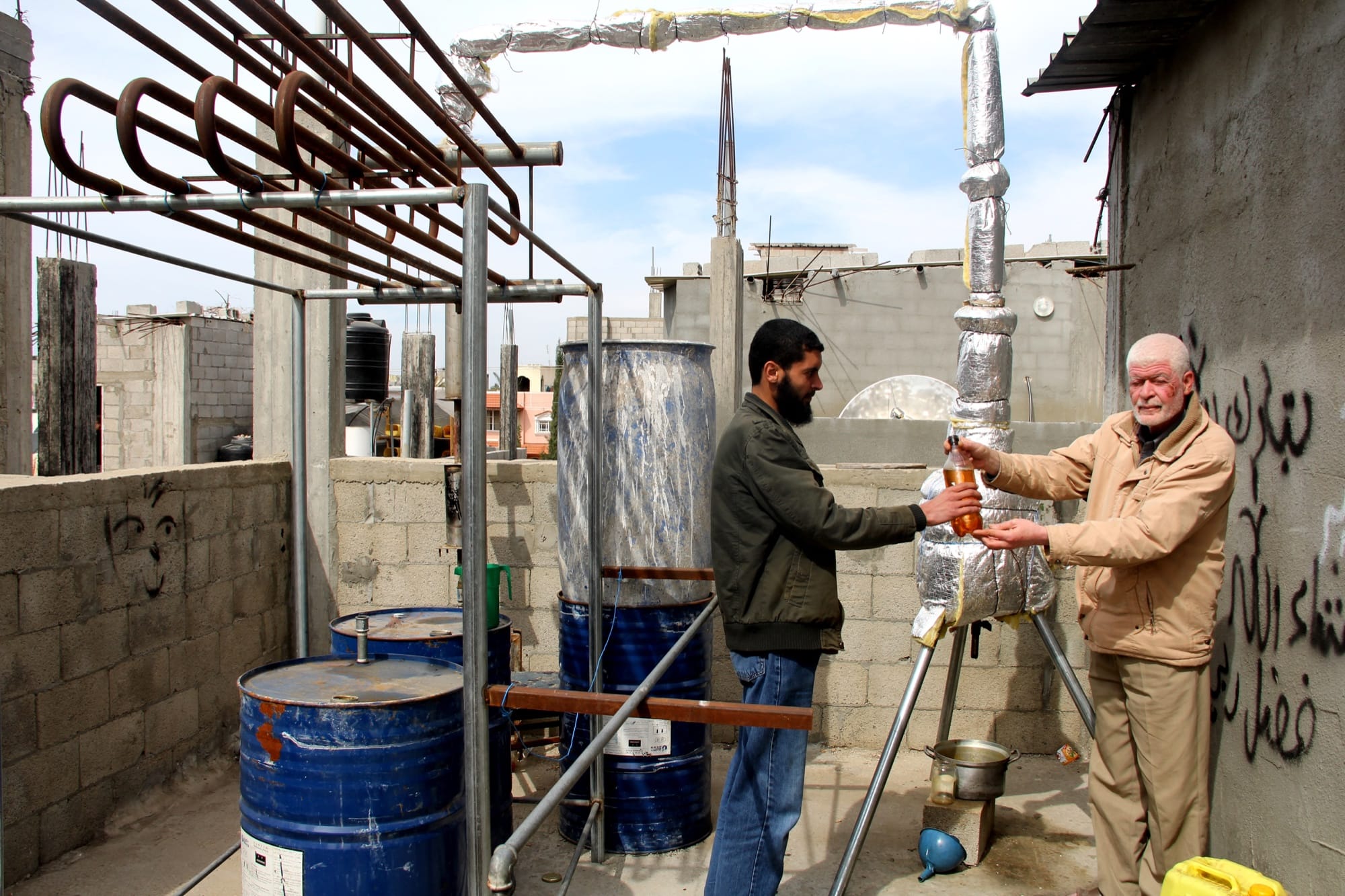
It’s not new news that there’s an oil crisis in Gaza. As Israel controls the volume of fuel going into Gaza via the Abu Salim crossing, this crisis has existed for almost a decade. Before the Egyptian army destroyed the tunnels between North Sinai and Rafah after the dismissal of former Egyptian president, Mohammed Morsi, the fuel was often smuggled over from Egypt and sold on the black market. And now, the city’s only power plant operates with minimal diesel.
It took a very simple observation by one Gaza resident to find an inventive way to solve this problem. After watching smoke fumes rise from a fireplace in his home, 55-year-old Ibrahim Soboh, from the Nusairat refugee camp in central Gaza, was curious.
He searched online and discovered that there had been experiments in America to repurpose such fumes. “We are not a country of oil,” Soboh told me in an email interview, “and we have to find ways to get gasoline and diesel.” With the help of his sons, it took him a total of seven months to construct his primitive plant, using basic materials bought with loans from a friend.
Although Soboh is understandably tight-lipped about exactly how the plant functions, we know that it heats plastic until it becomes vapour, then the same machine condenses the vapour until it becomes fuel. Every 1.5 kilogrammes of ground plastic results in about one litre of newly processed liquid fuel – a mixture of diesel, gasoline and kerosene – which can be used to run cars, heavy-duty machinery and electricity generators.
While Soboh has since been dubbed by some press ‘The Palestinian Alchemist’, admiration for his ingenuity is counterbalanced by the fact that the environmental damage of such production is likely to be high. It is also sure to be an extreme health hazard, due to the incomplete combustion of plastic, which can release carcinogens into the atmosphere. But with blockades on such essentials still rife, the future forced on Gaza seems to be one that revolves around local production and residents welcome the kind of initiatives that mean they’re able to live their day-to-day lives.
Soboh is currently seeking benefactors to make his plans for a large-scale power plant a reality, which he hopes to serve a much larger purpose to his community. “A functioning power plant could help find jobs for the unemployed,” he adds, not to mention raise awareness about recycling. For the moment, though, long-term goals are supplanted by short-term ones, and Soboh’s work is likely to be the blueprint for many other projects. After the events of August, in which there was catastrophic damage to Gaza’s infrastructure due to Israel’s seven-week campaign, this strain of resourcefulness is likely to be needed more than ever.
WHO Ibrahim Soboh
AGE 55 years old
WHERE Gaza
WHY This man has created a primitive refinery that turns plastic waste into usable fuel, which is so badly needed by the community