Having flown to Munich to attend BMW’s centenary birthday bash, I was fully prepared for a two-day marathon of endless conversations about 507’s, M3’s, Hofmeister kinks and ultimate driving machines but what I certainly didn’t expect was that one of their rivals might muscle in on the occasion. Yet that is what happened (to a certain extent).
You see, on the day of BMW’s birthday – March 7th – my alarm went off a little too early and trying to silence the ungodly sound, I instinctively grabbed my iPhone and fumbled a few buttons but that only made things worse because, in my haste, I had unwittingly unlocked the display. That, of course, lit up the homescreen, which had been left full brightness, and it felt as though a laser was boring into my skull. At this point, I had to admit to being awake, so I sat up and logged into Instagram, (hey, you never know, the sheer monotony of it might just have been enough to send me back to sleep) where, positioned on the very top of my feed was something highly unusual. It was a post by Mercedes-Benz yet the image was of BMW’s trademark double-kidney grille. Intrigued and confused, I pressed play. “Thanks for 100 years of competition,” proclaimed the message, “the previous 30 years were somewhat dull.” Brilliant, I thought; who’d have known the Germans have such a sense of humour?
But that wasn’t all, for later the same morning I was informed by another journalist that Mercedes had pulled off a second stunt: Daimler (Mercedes’ parent company) thought fit to send out a press release inviting BMW’s employees to come out and visit the Mercedes-Benz Museum in Stuttgart so that they could appreciate the full history of the automobile. The message was clear: Mercedes was the older car company and seemingly, the cheekier one too. Still, this was BMW’s day and I wasn’t going to let some trolling get in the way of it so I went and joined the rest of the media brigade, who were now boarding the buses to the BMW Museum for an early press briefing with the company’s top brass.
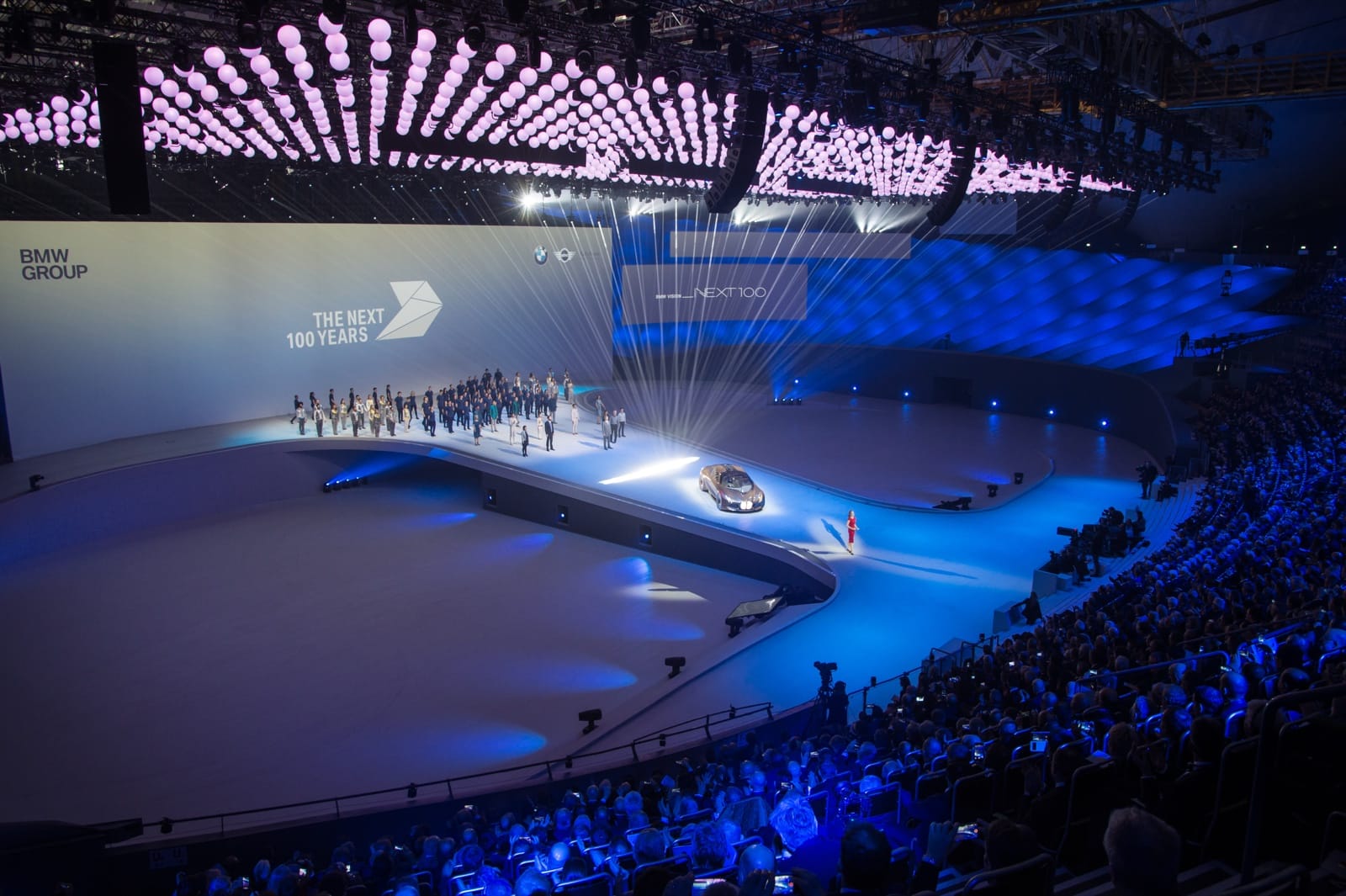
The location for the conference was the BMW Group Classic building (complete with a stunning 1957 507 roadster, 1972 3.0 ‘Batmobile’ CSL and a 1978 M1 supercar among its pristine classics). It was a fitting place, as it was here that the company first began manufacturing aircraft engines back in 1916. Of course, after the First World War, the Allies’ restrictions on Germany’s military capabilities led BMW to diversify, first with motorbikes in 1923, then with cars in 1928. As Harald Krüger, the current chairman of BMW’s board put it, “We are capable of reinventing ourselves whenever we need to.” And this was going to be the underlying motif of their centenary. Krüger continued, “We are capable of shaping the future. In our centenary year, we are deliberately looking not just back but, first and foremost, ahead – to the future: The Next 100 Years.”
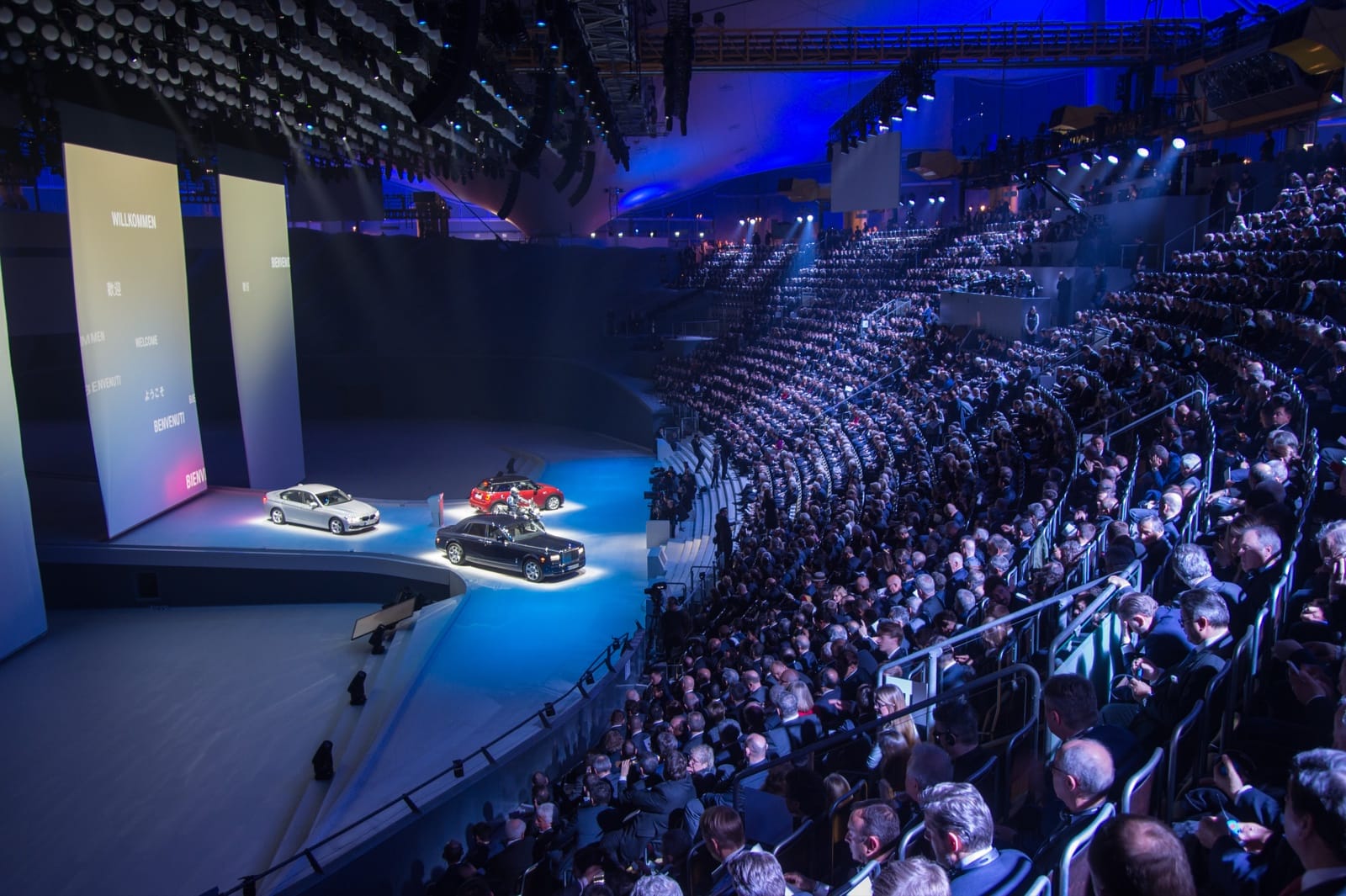
Though we were curious to learn more, the press were offered only a few teasers by Adrian van Hooydonk, BMW Group Chief Designer before we were then whisked back into the buses and taken over to Munich’s Olympic Hall. Here, 2,000 VIP guests (and a further 122,000 employees in 140 countries via live streaming) were treated to a spectacular Cirque de Soleil-esque multimedia show that showcased the key moments in the group’s history before ending with a climactic moment: the unveiling of the ‘Vision Next 100’ car by BMW, the first of four major concepts that’ll be revealed through the year (Mini, Rolls-Royce and BMW Motorcycle’s visions will all follow suit).
So, what does the future look like to BMW? First and foremost, it seems the combustion engine won’t survive much longer. Unlike Tesla who is betting big on electric, BMW wouldn’t hazard a guess as to which technology will emerge as the new standard but the omission of exhaust pipes indicates it’ll be a clean one. Such a step seemed to liberate the designers for it allowed them to ‘blend a coupé-type sportiness with the dynamic elegance of a sedan’, which, in layman’s terms means the car has the exterior dimensions of a 5-series but with the interior space of a 7-series.
Remarkably, BMW’s designers also avoided taking a defined position in the self-driving debate – so although the Vision Next 100 boasts autopilot capabilities, the driver will still have the option of taking control. Naturally, this pleased the bigwigs as it aligns nicely with the company’s reputation for building what it has described in the past as ‘the ultimate driving machines’. In fact, in an interesting twist on their catchphrase, the Vision concept car will actually make whoever takes the wheel the ‘ultimate driver’ too with the help of an interactive windshield, which is actually a massive augmented reality display that does everything from indicating the ideal driving line to flashing up alerts if an unsighted pedestrian or cyclist approaches the trajectory of the vehicle. But that's in what they call ‘Boost’ mode. In the alternative ‘Ease’ mode, the car takes over, the steering wheel retracts and the seats change shape to make driver-passenger communication more comfortable. Meanwhile, the nifty windshield display switches from being somewhat of a dashboard to a screen dedicated to entertainment. “If there is one thing we can be sure of,” explained BMW’s chairman, “it’s that future mobility will connect every area of people’s lives.”
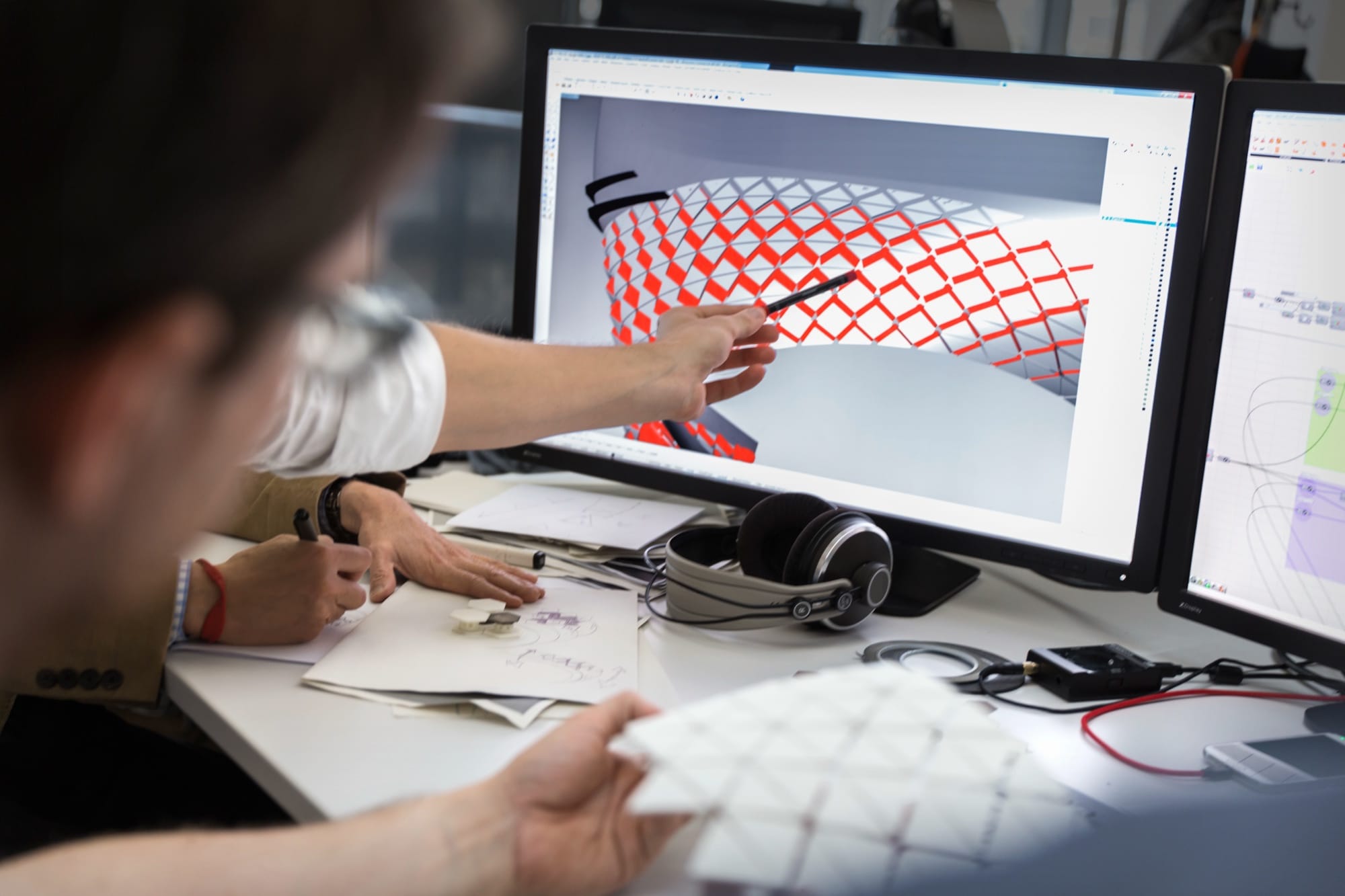
The connectivity aspect was certainly the most significant part of this reveal and the company pushed this idea to its limits with something they call ‘Companion’. Compromising 800 triangles embedded in the dash, Companion is a multicolour polygon system that is seen to communicate directly with the driver through gestural movements, rather than just two-dimensional displays. It also has deep learning capabilities so that, with time, it’ll eventually perform routine tasks on your behalf, while also offering pertinent advice at the most opportune moments.
It’s all very ‘Blade Runner’ but, something that had everyone oohing and aahing was a little more ‘Back to the Future’ and this was the surprising re-emergence of spats. Not seen since the flamboyant 1930s designs of now-extinct French brands like Delahaye and Talbot-Lago, BMW brought back these fender skirts but made them flexible, like some kind of reptilic exoskeleton. Constructed primarily from recycled materials and environmentally-friendly renewable resources, the Vision’s spats help cut down the car’s drag coefficient to an impressively minimal 0.18 but they’ll also stretch and allow the body to shape-shift whenever you turn the wheel.
There’s no doubting the Vision Next 100 is an impressive concept car but as Karim Habib, BMW’s Lebanese chief designer, mentioned, “Vision Next 100 is not the finished article, it is the start of an ongoing journey into the future.” And if we have learnt anything over the first 100 years of this company’s illustrious history, it’s that BMW has gotten to where it is today thanks to an unswerving commitment to producing excellent cars. The Vision Next 100 therefore is a test bed for future brilliance and we could start seeing its influences filtering into production cars within ten to 20 years.
Now, to get back to the reason why BMW never replied to Mercedes’ trolling, you’ll need to consider that the Munich-based company has held the global sales top spot since 2005 (with Mercedes in second and Audi in third). And even if the others are snapping at their heels, we think you’d agree that the best course of action for a leader in such a scenario would be to simply sit pretty. We therefore commend them for taking the high road – Happy Birthday BMW.