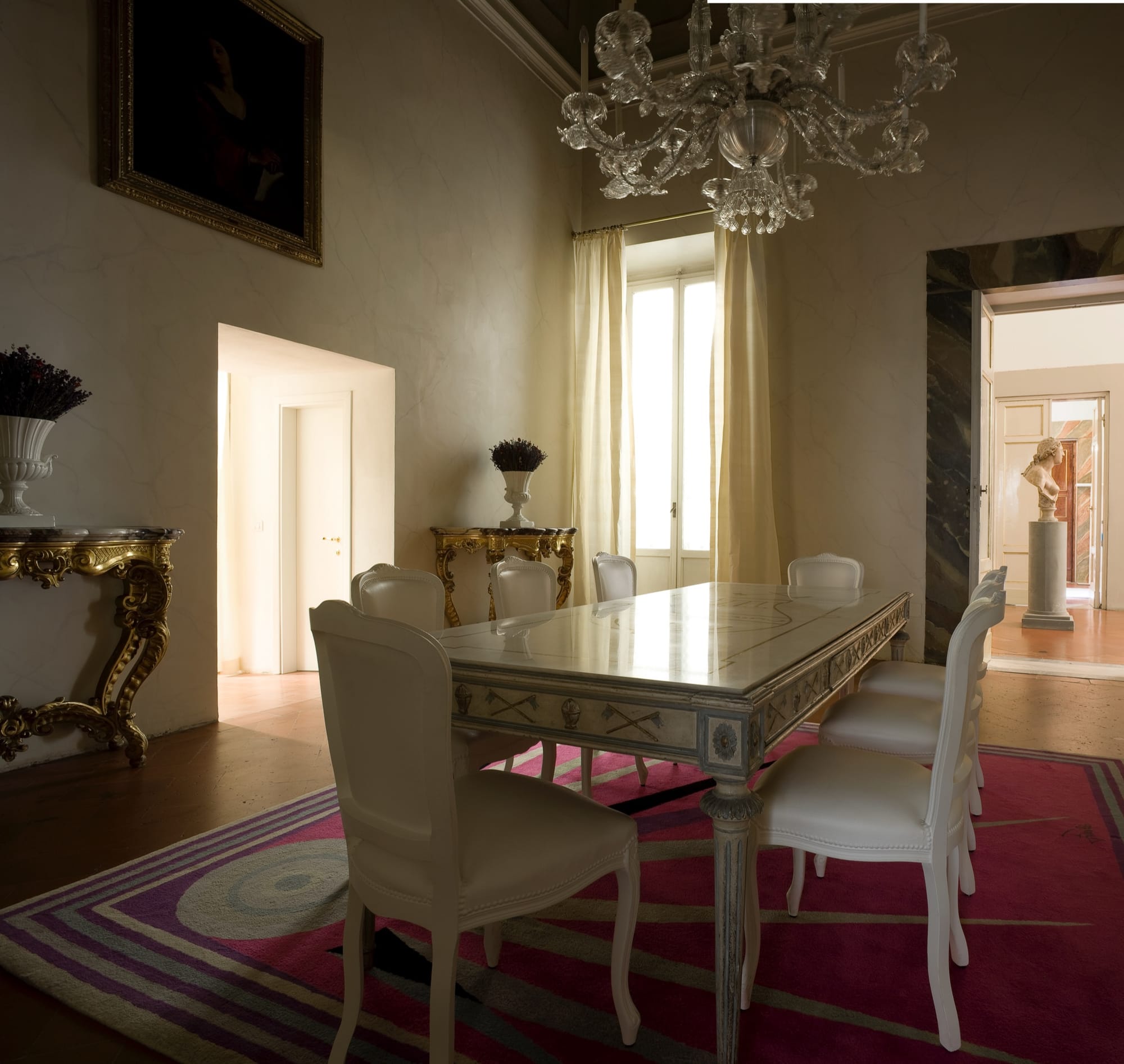
When Laudomia Pucci goes downstairs to her office in the morning, she walks past the wide corridor lined with paintings by Italian masters and descends the grand marble staircase of her 600-year-old Palazzo in Florence. The high-ceilinged, grand ballroom on the first floor functions as the main studio where the latest Pucci designs are created. From there, they are dispatched to Pucci’s global fashion empire.
Laudomia is Emilio Pucci’s daughter and the woman keeping the label’s spirit alive. The Italian marquis’ talents were discovered over 62-years-ago when Harper’s Bazaar published photographs of the stylish hooded parka and skinny ski pants that he had designed for his girlfriend during a ski-holiday on the Swiss slopes. He was encouraged to start designing and the following summer he created colourful hats and shirts from the island of Capri. His bright clothes appealed to a jet-set generation that had endured the difficulties of the Second World War; they were ready for a change.
Emilio Pucci is said to have been fond of mentioning that he was the first member of his family to work in a thousand years. A descendant of a noble Florentine family, he might not have exaggerated. The Pucci Palazzo in central Florence certainly breathes the grandeur of that wealth. The top floor is still used as the living quarters for Laudomia, her mother, her husband and their three children.
The maestro’s daughter explains that the Italian countryside and the Mediterranean way of life were the inspirations for her father’s work. It is the startling colour combinations and elegant, simple cuts that made him famous around the world. “The landscape of Capri, Sicilian mosaics, the palio of Sienna, Florentine architecture,” Laudomia says. “My father would say: ‘if colours are taken from nature, they cannot possibly clash,’” she laughs. His wild geometrics and multi-coloured, feminine designs made Marilyn Monroe, Sophia Loren and Jacqueline Kennedy loyal followers of the ‘Prince of Prints’.
The fashion house now has decades of experience with ready-to-wear. Pucci shoes, silks, eyewear and perfume are also doing very well. In May 2000, LVMH acquired a controlling stake in the company. Of this, Laudomia says, “They gave us opportunities that we previously could not have imagined. Not only because of the money but also because of the people,” she says in her office, where drawings of her three young children hang on the wall. She cannot predict whether her children will be involved in the business when they grow up. “If they’re good enough, yes. But they’ll have the choice.”
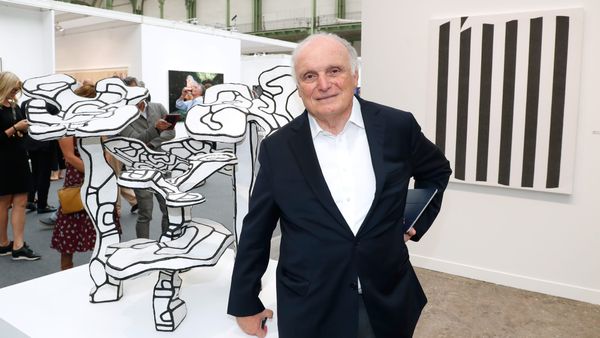
That art and fashion go hand in hand becomes clear during a visit to MaxMara’s headquarters. Located in the Po Valley, the village of Reggio Emilia is where it all began. The family passion for dressmaking started with Marina Rinaldi, who at the end of the 19th century ran an atelier in the heart of the village. It was her grandson Achille Maramotti that became the founder of the world famous fashion house MaxMara in 1951.
Achille Maramotti began collecting art in the early 1960s. He compiled a collection that mirrored the evolution of the most advanced artistic thinking of his time. The majority of his pieces, mostly paintings, sculptures and installations, date from 1945 until his death in 2005. Maramotti clearly had an eye for art as many of his pieces were the early works of artists who were still unfamiliar though they’d later become very famous. These include Francis Bacon, Alberto Burri, Eric Fischl, Julian Schnabel, and Ellen Gallagher. The collection was opened to the public in 2007 as the Collezione Maramotti in Reggio Emilia. When MaxMara moved to new headquarters on the outskirts of the village in 2003, it was decided that the original building would house the art collection, which continues to grow as some newly acquired paintings that were recently bought in New York are presently on display. A temporary exhibition shows 30 contemporary works made between 2001 and 2008 by artists who all live and work in New York.
The arts, and theatre in particular, are also Brunello Cucinelli’s passion. With profits from his thriving company - producing the world’s most delicate cashmere clothes, he built a theatre in the village of Solomeo, close to the city of Perugia. “The Teatro Cucinelli was built as a gift to the people of this village. I believe the community will benefit from gathering here,” he says and looks around the beautifully constructed 240-seat theatre.
Born in 1953, Cucinelli grew up to become a farmer. Until he was sixteen he worked on the land. “Then my father decided to take a job in a cement making factory, and became a factory worker,” he recalls. The young Cucinelli was appalled by the treatment his father received there. “He was insulted on a daily basis while it is so important that employees live and work in a healthy environment,” he says. Cucinelli says his biggest dream is to find a form of modern capitalism where profit is used to improve the condition of human life. “We have to create a new relation between owners and their employee’s. It is all about moral values.”
As part of this philosophical approach, he bought the medieval castle of Solomeo in 1985. It once was a beautiful place that had been abandoned and was in desperate need of restoration. It took him several years before he could move the company headquarters to Solomeo which today is a thriving village once more. “Brunello brought life to this village and that’s a gift for the community. The houses are alive again,” says one of his employees. She is working in one of the old houses, with samples of the new collection a few meters away. “We’re a human company. The way of life of our employees is really important. We pay good salaries, on average 20 per cent higher than others and that leads to a natural motivation to work hard. We don’t have long meetings full of unnecessary talk and our productivity is very high. They come and go when they want and no one has to clock in. At six o’clock everyone goes home, that’s a rule here,” says Cucinelli during a lunch of panzanella, a Tuscan bread salad, and other local Umbrian delicacies.
The ‘King of Cashmere’ swears he’d never buy a product that’s made without respect for the human being. As far as he’s concerned a consumer who wants a quality sweater that will last a lifetime and is 100 per cent Italian-made should be prepared to spend 600 USD to 1,000 USD. Cucinelli: “Italy has the know-how and the ability to create products with a culture and tradition that has been practiced for centuries. You don’t find that anywhere else.”
www.emiliopucci.com
www.maxmara.com
www.brunellocucinelli.com