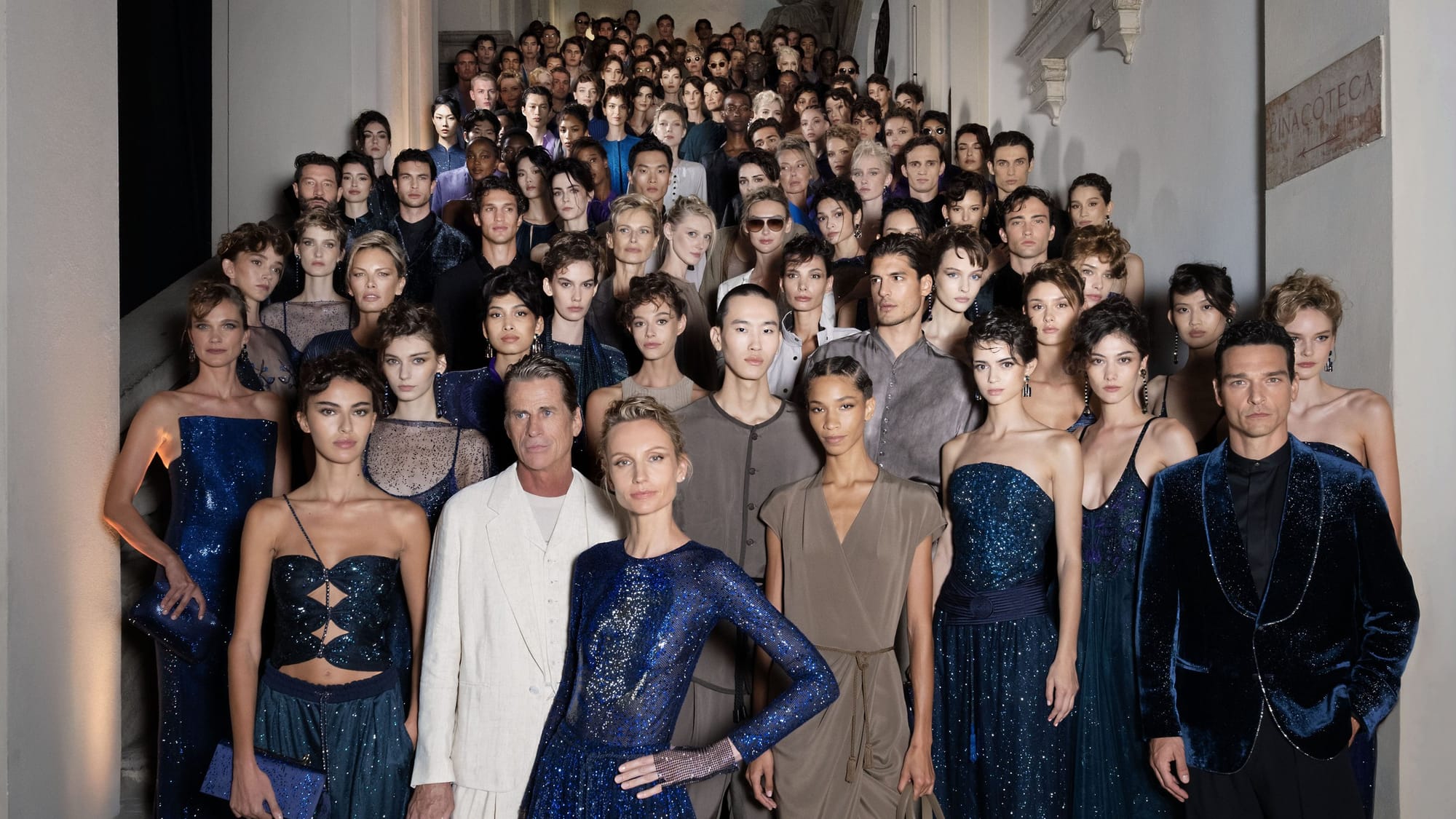
Not long ago, I asked Giorgio Armani how he planned to spend his retirement. He’d just told one of Italy’s leading newspapers, Corriere della Sera, that he meant to step down in two or three years, but even then he sounded unconvinced. “I’d like to spend my time in total relaxation, at one of my homes,” he said. “But the truth is, I’ve worked all my life and wouldn’t know what to do with myself. I simply wasn’t born to be idle, so three years could easily become many more.” The man could tailor a suit and dodge a farewell tour in the same breath.
Succession was the one outfit he could never quite get to fit. Family members were in the frame, notably his niece Roberta, yet no single heir emerged. “Of course, I care what happens when I’m gone,” he said. “But I’m still working out who should take over.” For now, the studio will carry the creative flame; longer term, names will swirl. Hedi Slimane, high priest of razor-edged tailoring, would be a canny choice. Clare Waight Keller (who served as the artistic director of Chloé and Givenchy among others) could bring sensitivity and finesse. From inside the house, Silvana Armani, who leads womenswear, and Leo Dell’Orco, who has helmed menswear and taken the bow at recent shows, look the most likely.
Slowing down? He didn’t do that. At the end of 2024, for his 90th and the brand’s 50th, Armani staged his spring 2025 show in New York. Not entirely coincidentally, he’d just opened a three-storey flagship at 760 Madison Avenue within a 400 million USD complex that also housed The Armani Residences – apartments priced from 8 to 32 million USD. All sold. The shop took in 3 million USD in two days. At an age when most people are learning the joys of the afternoon nap, he was still selling aspiration by the square metre.
Work may also have been a refuge. Sergio Galeotti – the love of his life and the man who insisted Armani had what it took to be a designer – died in 1985. Armani never appeared to find another soulmate. Instead, he put his heart into the work and set about protecting it. He built his own museum in Milan. He created the Giorgio Armani Foundation in 2016 to safeguard the company’s independence, support his chosen charities and, not least, stop anyone squabbling over an estimated fortune of around 12 billion USD.
He remained, to the end, a model of disciplined glamour: up at six, gym in the morning and again in the evening, an early ghost at his own celebrity‑encrusted parties. He took his catwalk bow, unfailingly, in a tight navy T‑shirt and chinos – a uniform not of humility but of intent. The look said: I have edited everything unnecessary. He was equally unedited in conversation. Media training had clearly bounced off him. Even in our era of hair‑trigger outrage, he spoke plainly and often mischievously.
Because he kept total control of his company, turning down all offers to buy in, he could afford to. His disagreements were never dull. Anna Wintour often skipped his shows; he noticed. Gianni Versace’s energy? Admired. His taste? Not Armani’s. Dolce & Gabbana? "Vulgar," he once shrugged. He felt John Galliano’s theatricality had gone too far. On Miuccia Prada, he told Corriere della Sera: "She lives more in the world of Miuccia Prada than in the real world. She doesn’t think about the fact that her dresses have to be worn by normal women." You may disagree, but you can’t accuse him of dithering.
Age brought a pang: no children. He found comfort in Bianca, the young daughter of an employee. "I consider her almost like my own, and this made me realise that I would have been a great dad." Conventional fatherhood was not to be. Instead, he founded one of the last great designer‑led houses. Giorgio Armani, launched in 1975 and kept in his own hands, changed how millions of men – and soon after, women – dress. Like Chanel and Saint Laurent, both of whom he admired, he invented a vocabulary. ‘Very Armani’ became shorthand for offhand glamour: cool, urbane and quietly expensive.
He took the soft tailoring of Naples and gave it a louche, sexy nonchalance. He made beige – that most maligned of colours – look sun‑kissed and cosmopolitan, as if it had a boarding pass. Richard Gere’s restless prowl through American Gigolo (1980) found its counterpoint in Armani’s calm, fluid suits; suddenly the wider world knew this name from Milan. Lauren Hutton, in an Armani trench, did not hurt.
Hollywood kept calling. He dressed some 200 films, and in real life he rewrote the red carpet. In 1989, Michelle Pfeiffer arrived at the Oscars in a black Armani tuxedo – a moment that proved minimalism could out‑drama a thousand ruffles. The Academy noticed. Tired of the naffness, they essentially let him sort it out the following year. At the 1990 ceremony he dressed Kim Basinger, Robert De Niro, Steven Spielberg, Julia Roberts, Jodie Foster, Denzel Washington, Daryl Hannah, Steve Martin, Tom Cruise, Jeff Goldblum and more. Women’s Wear Daily dubbed it ‘The Armani Awards’. Decades on, the label remains a go‑to. Cate Blanchett recently re‑wore an Armani Privé gown at Venice, a neat rejoinder to fashion’s attention span. Meanwhile, there’s a new fixation with ‘vintage’ Armani. "They don’t have a clue," a stylist told me, cheerfully. "Armani lends them something two years old and they think it’s from deep within the archives."
That story reveals both strength and flaw. On the plus side, the house stands for something immediately legible: refined, pared‑back European chic – endlessly copied, often badly. "Too much," he said last year. "For years by Calvin Klein, and not just by him. Even today, they’re still at it." On the debit side, his total authority meant he could be stubborn. He styled every show himself, which sometimes produced over‑zealous accessorising, severe make‑up and very thin models, and the shows could run long enough to test even Milanese patience. A younger partner – as the much‑needled Miuccia Prada has with Raf Simons – might have made the runway feel more plugged into the Instagram age and coaxed today’s starlets into current‑season Armani rather than ‘vintage’.
But if you looked past the noise, the essentials of Armani style never left the building: the impeccable drape, the soft shoulder, the way a jacket skimmed rather than shouted. While TikTok cheered the circus, countless men and women – famous, unknown, every age and shape – walked into rooms wearing Giorgio Armani and looked good. Relaxed. Confident. If you’re a designer, there are worse epitaphs.
Bernard Arnault, chief executive of LVMH, put it succinctly on news of his death: "I feel profoundly saddened by the passing of Giorgio Armani. He created a unique style, combining light and shadow, that he developed into a large and successful entrepreneurial journey and extended Italian elegance to a global scale. He was also a true friend and admirer of France. I wish to express my sincerest sympathy to his family."
It’s hard not to admire what Armani did. Without him, there would likely be no The Row, no Toteme, no COS – and the notion of ‘stealth wealth’ would still be a whisper rather than a dress code. He took ideas about taste and ease that drifted around Europe’s cafés and boardrooms and turned them into a practical wardrobe. A global audience, increasingly casual but still keen on standards, found a blueprint.
Postscript: In the end, Armani did leave clear instructions. In the short term, his partner in work, Leo Dell’Orco, will steer the company. Over the longer term, he told his heirs to explore a sale to a player such as LVMH, L’Oréal (already a partner in beauty) or eyewear giant EssilorLuxottica. For a man who perfected the soft shoulder, even his exit strategy had clean lines.