How does one turn the mundane into the exceptional? This is a question asked by every luxury goods manufacturer aware that we live in a world where discerning individuals who appreciate excellence would always rather own a fine fountain pen than a throwaway ballpoint. So what can one do with the most ubiquitous of modern devices: the mobile phone? Vertu, is the answer.
When the ‘smartphone’ was born, mobile phones evolved to do much more than merely handle voice calls. Texting, music-and-movie playback, cameras and a seemingly infinite number of apps transformed the voice-only phone to a total comms-to-entertainment convergence, where you could carry your whole audiovisual world around with you. Adding to this industry of complex, ever-present pocket-sized devices is Vertu, a luxury brand that was established by Nokia in 1998 (before it was sold in 2012) to transform the mobile phone into one of the finer things in life, by aptly identifying the select segment it would appeal to.
Vertu’s Aster model is the slightly more affordable one in the range, starting at 7,000 USD, compared to the Signature Touch’s base price of 10,000 USD. Strangely it’s almost identical in size to the latter so the differences are down to a shorter concierge subscription, the loss of a dedicated agent and a slightly larger girth. The plus side is a larger standard colour range.
From the launch of their initial model in 2002, Vertu has offered a few key elements that have decidedly positioned their phones as upmarket. First was a build quality that buyers might have previously associated with luxury watches, meaning that plastics or even certain metals would not suffice. And by using precious materials, the phone would offer the same tactile delight as a piece of jewellery. Secondly, in addition to the standard phone features, there are Vertu-specific applications such as Concierge and Certainty. The concierge service concept is similar to that provided by ‘platinum’ and ‘black’ credit cards but with greater scope, interactivity and personalisation, providing access to priority bookings and the most exclusive private members’ clubs, as well as a dedicated do-anything team, while Vertu Certainty offers high-tech integrated security of your data. There’s even a Lost Phone service that enables the owner to lock, find, ring and wipe his or her Vertu at any time, should the phone ever go missing. The final element was inherent in the proposition: exclusivity allied to customisation, making Vertu a mobile phone unlike any of the – literally – billions on the planet.
Because Vertu is British, it is part of a long tradition of companies that address the manufacture of the most desirable shoes, clothing, sporting guns, luggage and other trappings of the good life. So Vertu’s main challenge was to create a sense of permanence and desirability in a device that, for the masses, is like seasonal fashion, covetable only until the arrival of the next operating system.
But how do you succeed with a base model that starts at around 7,000 USD, and that’s before you’ve even customised it? The answer is: with superlative build quality and elegant styling to make the kind of phone that one would never drop, lose or leave on a plane.
Vertu’s former chief executive officer, Massimiliano Pogliani, (who just resigned from his post following the sale of the company by Swedish private equity firm, EQT, to Hong Kong-based Godin Holdings) explained why their phones can cost ten times as much as the latest iPhone. “As consumers, we expect certain things from our mobile devices. Vertu has developed its products to ensure that they feature state-of-the-art technology that allows owners to manage their social media, emails, contacts, music, pictures and video from their phone.” He’s committed to the belief that ‘the Vertu technology experience’ has to surpass the best products available on the market. “However,” he says, “technology is where the mass market stops and we really begin. A Vertu phone is produced from carefully selected, handcrafted materials that deliver the quality that luxury consumers recognise in the other goods that they own.”
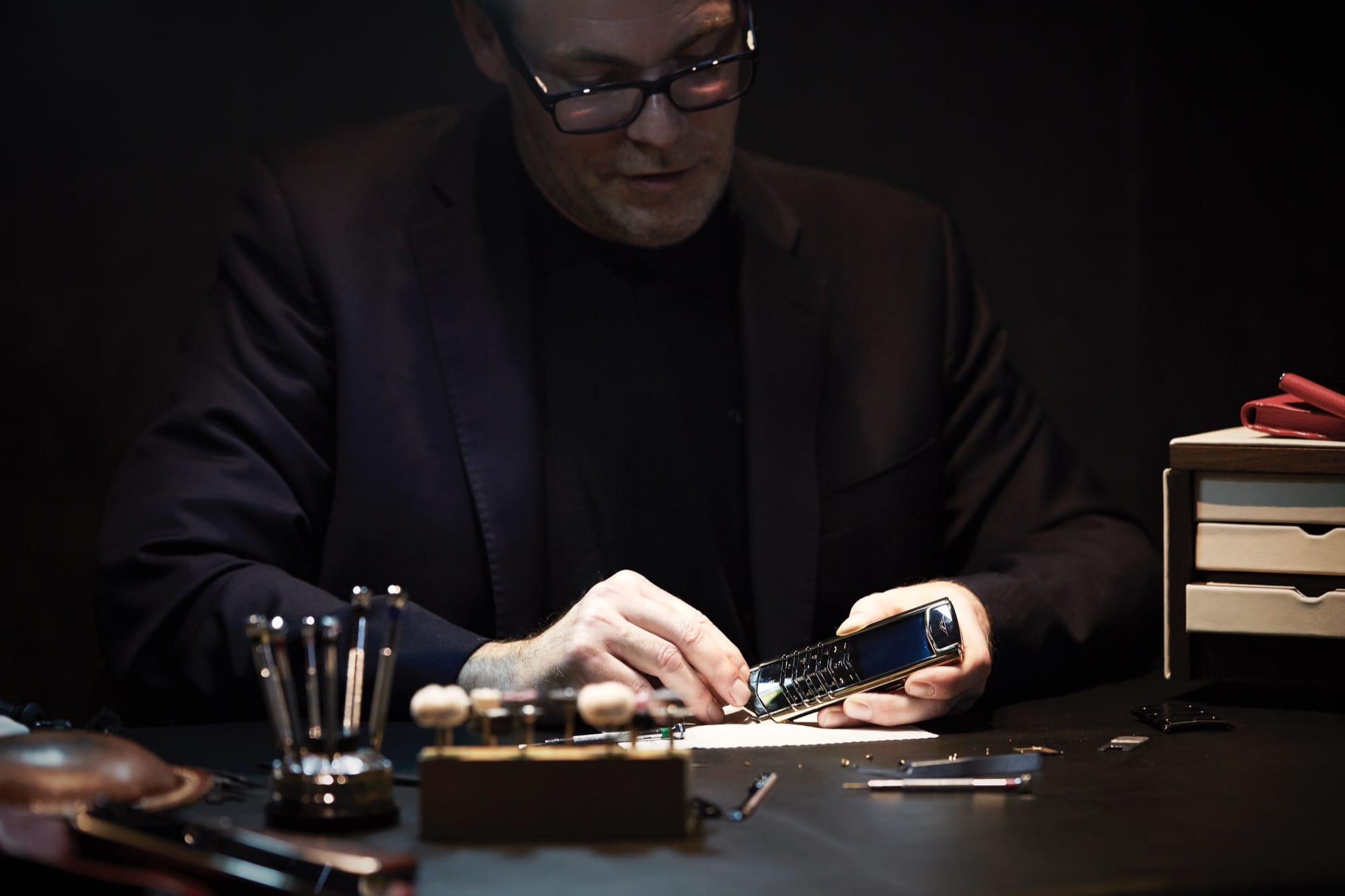
If one imagines that all phones are made in massive, automated factories, then Vertu hearkens back to the era of bespoke clothing and automobiles with custom coachwork. Each and every Vertu, since the first model, has been handmade one at a time by a single craftsman (whose name is then engraved inside the phone) at the company’s small factory in Church Crookham, in Hampshire, which, though it’s ultra-modern, is a real throwback in terms of its artisanal character.
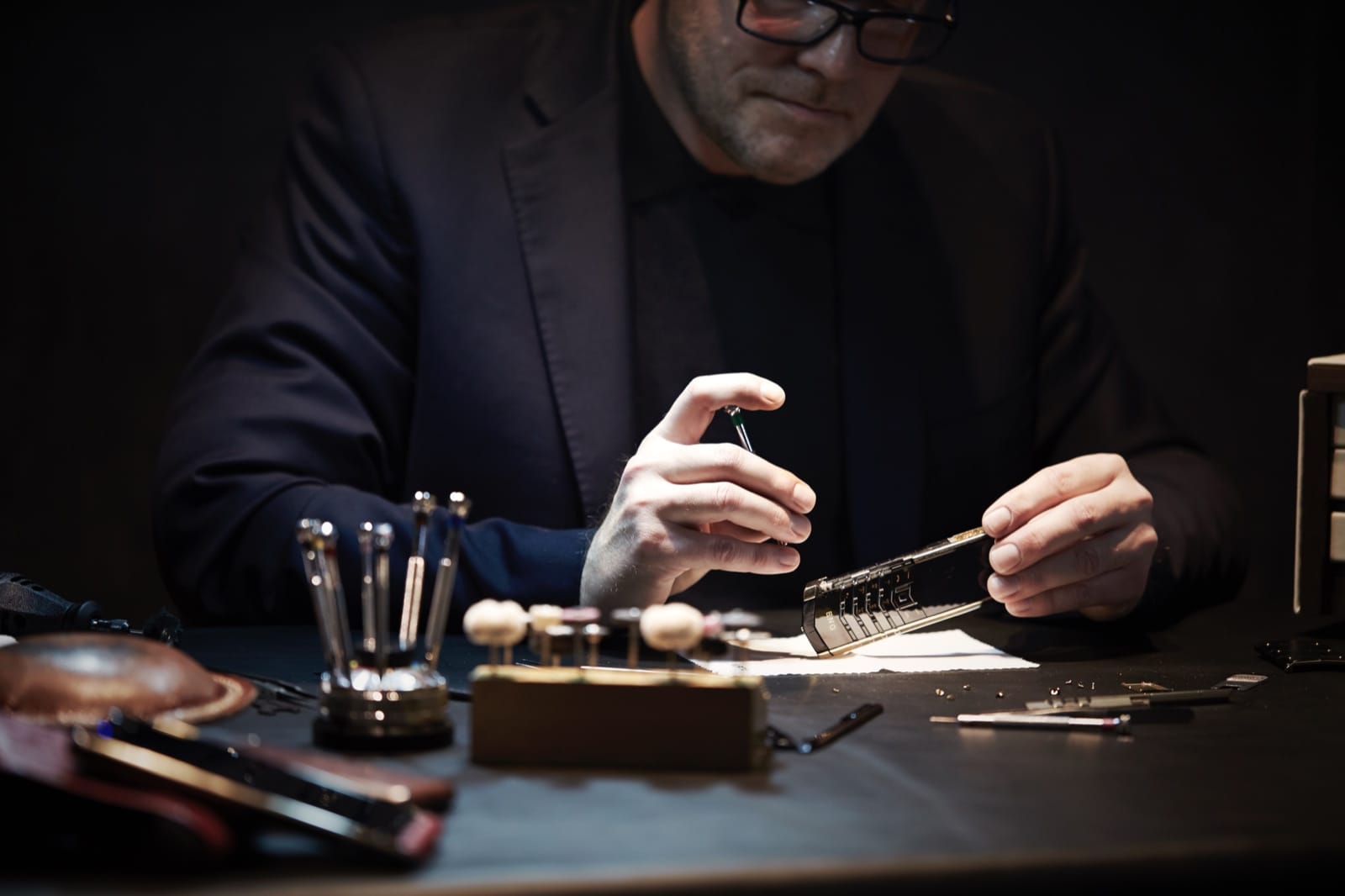
There are no conveyor belts at Vertu. One worker is responsible for building each phone from start to finish, and each handset is engraved with his or her signature upon completion. This personal touch is appreciated by the customers, who occasionally request a particular person to build their next phone, which in turn feeds into the job satisfaction and pride of the people doing the assembly.
Here, the craftsmen exhibit the necessary skills – beyond those needed for the actual electronics part – required to work the exotic materials that make up a phone. Among the talents vital to Vertu are those that would not be out of place in an atelier producing fine jewellery or handbags since Vertu’s workforce can deal with rubies, sapphires, exotic skins, titanium, even vulcanised rubber, finishing everything by hand. Speaking of materials, Vertu pioneered the use of sapphire crystal for its screens but, says Pogliani, “It is perhaps our unique services proposition that really differentiates Vertu from other phones and enables us to have a genuinely personal relationship with our customers.”
If you remain sceptical about a phone with a price tag similar to that of a rather fine watch, this should dispel your doubts: Pick one up in a Vertu boutique, smell the leather, feel the heft. Run a finger along the perfect edges. Turn it on, notice the quality of its Bang & Olufsen speakers, sample some of the ringtones created by the London Symphony Orchestra and try out its Hasselblad-developed camera. This is not an everyday phone. It is precisely as the name reminds us: an “objet de vertu” in the most literal sense.
Left: Here you can see that the craftsman was in fact working on an Android-powered Signature Touch in a Clous de Paris finish, which marries matte grey alligator skin with grey DLC coated guilloché titanium. Right: The new Signature Touch with garnet calf leather and contrasting stitching is complemented by both brushed and polished titanium metalwork.
WHAT Vertu
FOUNDED 1998
BY Nokia (1998-2012), EQT (2012-2015) and now Godin Holdings (2015-present)
WHY It’s not just that Vertu’s mobile phones are handcrafted from expensive materials and come with their own embedded concierge system, these phones offer the best mix of luxury and high-tech power to match some original good looks.