‘AGi Architects is an international design firm providing comprehensive services in Architecture, Planning, Urban Design, Interior Design, Design research and Consulting, allowing the creation of places that provide lasting value’. Speaking with founding partners Nasser B. Abulhasan and Joaquin Perez-Goicoechea offers a personable understanding of AGi Architects’ offering. Behind the impressive introductory statement and sleek website lie two very engaging and warm individuals, who convey their passion for Architecture (with a capital ‘A’) as successfully as their fondness for each other. Conversation is rife with ribbings and the sort of camaraderie that only comes from genuine friendship: “meeting Nasser changed my life – I am still not sure whether for the better!” and when one loses his train of thought the other is quick to finish the sentence. Despite the clear joviality, a brief glance at some of AGi’s past and current projects reveals a niche agency rapidly burning up the architectural field. A chance meeting at Harvard Graduate School in 2000 led to the founding of AGi Architects in 2005. In between, Spanish Perez-Goicoechea and Kuwaiti Abulhasan spent time working on their respective portfolios, the former as Director at Cruz and Ortiz in Amsterdam, while the latter lead numerous urban planning projects across the Middle East.
Today, theirs is a long distance relationship (so to speak). Dividing their time between their mutual hometowns of Madrid and Kuwait, Perez-Goicoechea and Abulhasan achieve the impossible – a seamless thread of creativity and strategy resulting in a series of homes and commercial spaces each one more impressive than the next.
Having formed a mutual respect during their days as classmates, co-founding their own firm felt like a natural career progression for both partners. In spite of AGi standing for ‘Abulhasan Goicoechea International’ however, neither of them considers the firm to be a reflection of their sole selves – in fact they have never publically addressed the meaning of the initials. “It is not a boutique office with only Nasser and Joaquin – there is a whole team behind it.” In the 6 years since it was formed, AGi has grown considerably and today employs a team of over thirty staff, specialising in the fields of architecture, interior design, planning and landscape architecture. A third partner has also been brought on board, whom they also consider a friend above all else, “Architecture is very complex – you have to put in so much of yourself, you need to feel comfortable with your surroundings first. Trust is key.”
Though residential is their first love, AGi has become increasingly important in shaping the landscape of numerous cities worldwide. Their submission for the Hobart Waterfront International Competition (Australia, 2006) and the Madrid Court House (Spain, 2007) earned the firm honorary mentions and instant recognition as a serious urban planner. Most recently, they have been involved in the creation of the Kuwait Children’s Hospital and the Haj House Complex in Lucknow, India, two very diverse but equally worthy projects that are reinventing our perceptions of healthcare and religion.
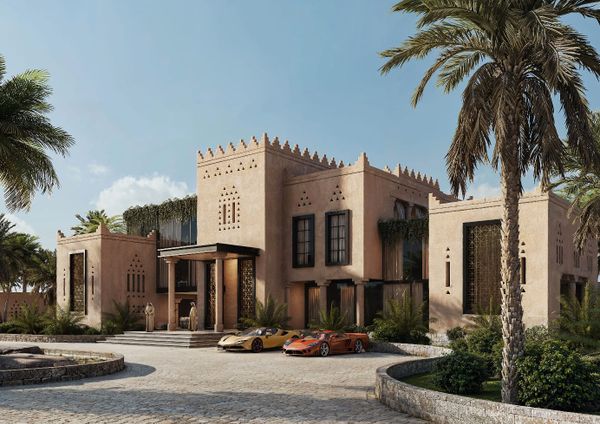
Their progression from private residential to large scale urban developments has been an organic one and, by their own admission, an emotional one. Their first commission as AGi Architects was from a high profile Kuwaiti wishing to create his dream home on the coast – the result was ‘Star House’, a property as magnificent as its owner (apparently – AGi highly values discretion, and will never reveal their clients’ identities). Briefed on the owners need for total privacy as well as uninterrupted views of the sea, AGi set about creating a property that today consists of a main house, two bungalows and a boathouse. As is customary with AGi properties, emphasis has been placed on the ecological aspects of the house, ensuring that whatever natural elements can be converted into energy are used effectively. Thus parts of the house are sunken underground for insulation purposes, while the entire South facade, which faces the harsh summer sun and dry desert winds, is closed. The Northern, sea facing, aspects of the house are instead opened up to maximise movement, light and a refreshing sea breeze.
Juxtaposed with ‘Star House’ is the architectural and social feat that is the Haj House Complex in Lucknow, India. The project was rife with potential for offense, being an important place of worship for Muslims the world over, yet situated in a town where only a small percentage of the population follow the Islamic faith. For AGi, the project represented an opportunity to address Lucknow’s non-Muslim community and reconcile their beliefs with their neighbours’. Sensitive to the fact that the building’s main function would be transient, AGi also set about ensuring that a part of it served a year-round purpose. Thus, a cultural centre forms an integral part of the design, which also consists of an office building and accommodation for pilgrims. Beyond the religious context of the building, AGi was keen to ensure that the design was neither intimidating nor alienating and that it was superficially attractive, “You have to make sure you find the common ground between people – like with any type of city planning.” The planting of trees and gardens ensures that there are numerous elements to the hybrid building that resonate with all visitors, regardless of faith.
Personality is a key component in guaranteeing the success of any of AGi architects’ projects. A team is carefully selected in order to fulfil the needs of each task, but clients are encouraged to interact with their team as much as possible so as to achieve a level of understanding and trust. The potential for misunderstanding or misinterpretation, especially common on residential projects, can lead to some very expensive mistakes. Continuous dialogue and communication are essential in order to avoid such situations.
In the end, how does one gauge the success of a project? The answer for AGI lies in the client’s long-term reaction to the space that they have created, and whether it truly reflects their needs. For private residences, achieving such a sense can be a lengthy and complex process, often requiring the architect to adopt skills usually reserved to psychologists in order to better understand their client. Careful consideration is given to how the inhabitants interact (whether they are a close-knit family who enjoy their own privacy or a young couple who like to entertain), but a large amount of importance is placed on those elements of the client’s personality that may not be so glaringly obvious. AGI aim to reflect this dichotomy in their designs, often creating a facade in line with the resident’s public persona, which in turn conceals an interior suggestive of intimacy and secrecy. Returning to the project months after completion will often give AGi clarity on whether or not their venture has been a triumph. “We went to tea recently at one of our residential projects – watching the family in their new home, utilising the space with such ease, as though they’d always been there – we realised the house was even more of a hit than we had anticipated.”
For commercial enterprises, the success of the building tends to be more obvious. The Haj House Complex in Lucknow has won numerous awards, including the Commercial / Mixed Use Future award at Cityscape in 2010 and a Finalist award in the World Architecture Festival Awards in 2010. Such recognition is doubtless a much-coveted seal of approval, propelling AGi’s profile and popularity ten-fold as well as offering further endorsement of their work, “It is recognition of the sector to our philosophy and also encouragement for us to continue working in the same path.”
Another of AGi’s projects to garner an array of well earned awards is the Children’s Hospital in Kuwait, which won first prize at both the World Architecture Festival Awards and Cityscape in 2010. For AGi Architects the recognition was especially poignant, having been, without exception, the most emotional project that they have worked on to date.
The brief was very simple – to create a hospital for desperately ill children, without making it feel like a hospital. Remembering their own childhood as well as studying the psychology of children inspired AGi to strip the hospital space of any impersonality and instead make it feel like a home, complete with a fictitious family. The psychology behind this decision was that the space ought to be an aid in the children’s recovery; something that they found could be achieved through a continued positive experience. From the building’s ‘colourways’, to its fortress-like appearance therefore, the Children’s Hospital in Kuwait is entirely centred round the emotional needs of its end-user, the children. In addition, AGi took into consideration the needs of the children’s families, offering them leisure facilities such as a shopping mall, restaurants, a dry cleaner and a gym in order to maintain a semblance of normality at a time of great emotional strain. Donors and benefactors were also recognised in the design process, ensuring that the finished product was a reflection of them and that their own personalities were included where appropriate. The originality of the proposal and the successful marrying of emotional and physical care ensured the recognition of the World Architecture Festival jury.
For most of us, our greatest legacy will be those that we leave behind, those whom, we hope, will continue to speak highly of us even when we are long gone. For AGi architects their legacy will be somewhat more public, as they continue to establish themselves as a leading purveyor of stylish homes and cutting edge commercial spaces to be used by generations to come.