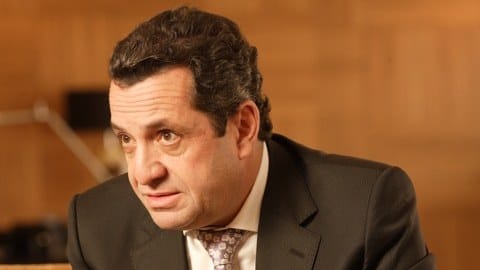
Well, maybe that’s not quite true. I am at the home – and not the clinic – of one of the region’s most dexterous, sought-after and celebrated plastic surgeons. Contrary to my expectations, Dr. Makram Abi Fadel is gentle, soft-spoken and a little bit demure. Tall, fit, with classically-styled jet black hair, I find him sitting in his conservatory-cum-patio overlooking Beirut’s quaint but chic Sursock Street. He is fiddling with what looks to be a mobile phone or a palm pilot or something of that nature. “Technology plays a big role in our lives,” he says, “but I am a Buddhist at heart and I believe in a return to a person’s essence. And without the essence of man to create and affect change, then we wouldn’t be where we are at today. In my view, the human being is the most important man-made product.” This is not where I expected our conversation to be heading. What happened to all the talk of celebrity do-overs, noses, breasts, behinds and beyond? And wouldn’t you think that silicon would be man’s most powerful creation? “I have arrived where I have always wanted to be, through hard work and sacrifice. And now that I am here, I have more time to reflect. I am not after the cash of aesthetic surgery, I am after the pleasure of bringing happiness to others,” he clarifies.
A graduate of a clutch-full of some of the best French and Lebanese universities, Dr. Abi Fadel returned to Lebanon in 1991 just when plastic surgery was in its mass-market infancy. “I started off in reconstructive surgery which requires changing an abnormal situation into a normal one. But later, I found myself more in aesthetic surgery. I garner happiness from helping to make things more beautiful,” he says. And the most beautiful woman is? “Well that is subjective. A woman should be looked at as a whole inside and out,” he retorts. “But I do think that the world should be run by women. They are able to multitask and they have a higher tolerance for pain in general,” he adds. According to Abi Fadel, men who go under the knife tend to be more difficult to work with, have less knowledge of the procedures and are less able to “put things into perspective.”
In spite of all his talk of being ready to wind down a little, Abi Fadel is an incurable workaholic. Try this one on for size. In the week in which we met, he had performed up to 40 different surgeries alone – an astonishing number on all accounts. “I don’t stop between surgeries. I just move on from one operation room to another. While I am performing one, another patient gets prepped and so on and so forth. I don’t really have lunch but when I get hungry I eat a sandwich even though, mind you, I am a gourmet,” he points out. “I get home on average at 11pm,” he says then quietly adds “my wife Rosie waits up for me.”
But the good doctor does like the finer things in life. He recently purchased a Bentley after scouring the market for a sportscar that was luxurious, fast and comfortable. His home is warm and welcoming with a cacophony of different artworks scattered along the walls; from a King Arthur-like surrealist painting of a woman’s hands coming out of the water, delicately engulfing a rose with thorns to the more abstract themed canvases – the Abi Fadels furnished their home themselves.
We pause at the entrance where stunning and convoluted sculptures by French sculptor Dominique Polles act as a convivial welcoming committee. “My husband collects art, watches and cars,” says the amiable Rosie Abi Fadel. The doctor shoots her a look. “I don’t want to talk about that,” he interjects. Undeterred she continues, “He also likes quick and intense travels, like dinner in Paris.” Unpretentious and modest even, the doctor offers, “It’s those small things that count.”
From Dawn Until Dawn
Dr. Abi Fadel doesn’t follow a conventional daily routine. His mornings start at 6am and he is in surgery by 7.30am. “I like to work on the cases that need the most attention earlier during the day; on the surgeries that need a bit more creativity like the nose or the breasts. The surgeries that are a bit more systematic, I tend to leave for the afternoon.” For Abi Fadel, work is work and he allows himself very little distraction. His phone remains unanswered and left to collect a swarm of missed phone calls. His 16 hour days also include consultations on Monday, Wednesday and Friday; the other two days involve back-to-back operations. “I don’t think that you necessarily choose a profession but I think that the profession chooses you. What I mean by this is that if you are good at something, then you will be in demand for that particular thing,” he says. On the weekends, Abi Fadel’s favourite pastime is attending to his garden in his Beit Mery home. “It’s a feeling. When I look at a garden, work of art or woman, I want to do what I can to make them better. I would say that I look after my garden like I look after my patients,” he says.
Abi Fadel’s Two Cents On
Beauty “It is very subjective. But in three words I would describe it as intelligence, harmony and peace.”
Surgery “In this profession you need skill and honesty. You cannot hide yourself and you cannot forget that you are a doctor first and foremost. As an aesthetic surgeon, the burden of proof is in the results.”
Ethos “I always tell my children to aim high and work hard. Only then will they achieve what they want in life.”
Prized Possession “My family. Rosie and my two sons.”
Luxury “For me luxury is not an aim in itself. It is to be in harmony with yourself.”
Free Time “I enjoy gardening and reading. I particularly still refer back to La Fontaine’s Fables. It caricatures life and people as they used to be 400 years ago, as they continue to be and as they will always be.”